What buyers really mean when they ask about a solar storage inverter system
A solar storage inverter system is not just another box in a renewable energy project. For engineers and sourcing teams, it is the part that decides whether solar generation can be used immediately, saved for later, or turned into a reliable backup source when the grid is unstable. In practical terms, the system links photovoltaic input, battery storage, and power delivery so energy can be managed instead of simply consumed as it is produced.
That matters because solar output rarely matches demand hour by hour. A factory may need power at night, a commercial building may want to shave peak charges in the afternoon, and a remote site may need a steady supply even when the utility feed is weak. The right configuration can reduce operating cost, improve resilience, and make a renewable project easier to justify. The wrong one, on the other hand, can create service headaches, wasted capacity, and a lot of avoidable finger-pointing between equipment suppliers.
FAQ: Is this the same as a solar inverter with battery storage?
Often, yes in function, but not always in hardware layout. A solar inverter with battery storage usually describes a system where inverter and storage are designed to work together. In some projects, that is a compact residential cabinet or wall-mounted unit. In others, it is a larger industrial cabinet with separate electrical compartments and service access doors.
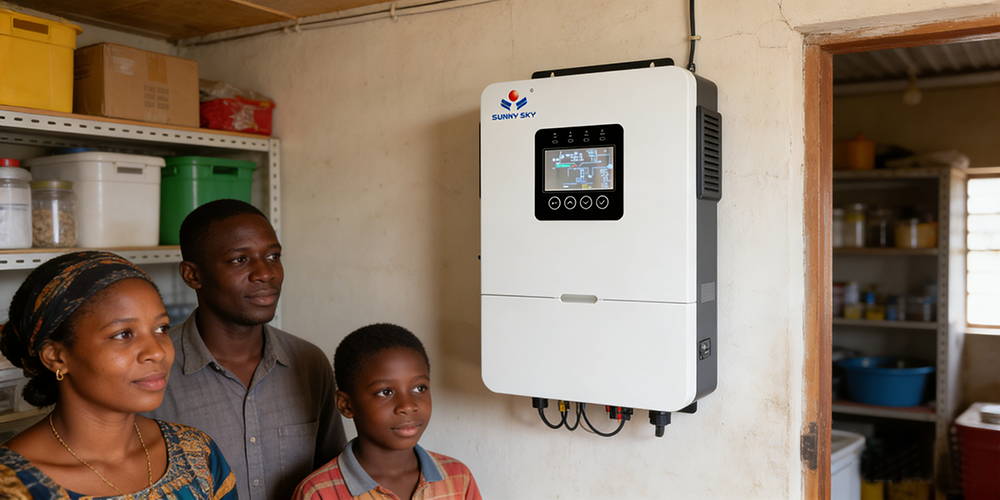
The visible product described here looks more like an industrial battery energy storage system cabinet than a small household appliance. It has a floor-standing metal enclosure, front access doors, warning labels, ventilation provision, and an emergency stop or rotary disconnect. Those are the cues buyers should notice first, because they signal a system intended for serious load management, backup power, or renewable integration.
FAQ: What does the cabinet design tell you?
Quite a lot, actually. The light gray painted or powder-coated sheet-metal enclosure suggests a fabricated industrial housing rather than a consumer-style unit. Dual front doors make inspection and servicing easier. The black base frame implies the system is meant to sit on a stable floor in a plant room, electrical area, or similar controlled environment. The visible ventilation grille hints at thermal management, although the exact cooling method is not visible and should not be assumed.
For buyers, these details matter because they affect installation planning. Service access, clearance, and cable routing are not afterthoughts; they influence maintenance cost over the life of the system. A neat cabinet still needs practical access for technicians, especially in commercial energy storage inverter deployments where downtime is expensive.
FAQ: Which applications fit a system like this?
This type of solar power storage inverter solution is typically relevant in industrial facilities, commercial buildings, microgrids, renewable energy storage projects, backup power systems, and sites that need load balancing or peak shaving. It may also support a home solar storage system in some product families, but the cabinet form shown here points more naturally to larger commercial or industrial use.
For a residential energy storage inverter, buyers usually want compact size, quiet operation, and simplified installation. By contrast, a commercial solar inverter or industrial storage cabinet must handle heavier duty cycles, more complex electrical integration, and stricter service planning. Matching the product class to the project is one of the most common sourcing mistakes, and one of the most expensive to fix later.
FAQ: What should you check before selecting a hybrid solar inverter system?
Start with the application, not the brochure. Ask whether the project needs backup only, self-consumption optimization, peak shaving, or grid support. Those use cases can point to different inverter topologies and battery configurations. A hybrid solar inverter can be a good fit when solar, battery, and grid interaction must be managed in one platform, but the exact control strategy still needs to be confirmed.
Then review the less glamorous details: cabinet footprint, ventilation requirements, service access, protection expectations, and the electrical interface with the rest of the plant. If the system is part of a photovoltaic inverter system, confirm how DC and AC paths are separated. If it is part of a battery energy storage system, ask how the enclosure supports inspection and isolation. Buyers sometimes focus on capacity and forget the cabinet. That is a mistake. In the field, the cabinet becomes the thing everyone has to work around.
FAQ: How do industrial and residential needs differ?
An off grid solar inverter for a cabin or small site is usually judged by simplicity and robustness. An industrial cabinet is judged by uptime, maintainability, and integration flexibility. That difference sounds obvious until a procurement team tries to substitute one for the other based on price alone.
Guangzhou Tianyuan Solar Equipment CO.,LTD, operating under SUNNYSKY, states that it has independent R&D and patented technologies, with products reaching more than 50 countries. The company also emphasizes stable performance, design, and ongoing investment in energy efficiency and reliability. Those are useful signals for buyers evaluating a manufacturing partner, especially when the project involves customized energy storage or solar equipment. As always, the final technical fit still needs to be checked against the actual project spec sheet.
FAQ: What common mistakes should buyers avoid?
Do not assume every storage cabinet is outdoor-rated just because it looks rugged. Do not assume the cooling method, battery chemistry, inverter presence, or communication package unless those items are clearly documented. And do not let the search for a lowest-cost solar inverter with battery storage override the basics of service access and electrical compatibility.
Another practical caution: the emergency stop hardware and warning signage are useful indicators of industrial intent, but they are not substitutes for full technical documentation. Confirm what is inside the cabinet, how it is assembled, and what after-sales support is available. For commercial buyers, factory visits can be worth the time; Guangzhou Tianyuan Solar Equipment says it is located about 20 minutes from Guangzhou Baiyun International Airport and welcomes global clients to its factory. That kind of access can make supplier evaluation much easier.
FAQ: What is the next step for a buyer?
Define the project’s operating profile first: load shape, backup duration needs, grid conditions, and installation environment. Then request a configuration that matches the project class, whether that is a residential solar storage inverter, a commercial solar inverter setup, or a larger all-in-one cabinet for industrial power management.
If you are comparing options, ask suppliers to separate what is visible from what is verified. That keeps the discussion honest and shortens the path to a workable design. A good solar storage inverter system should make energy easier to use, not harder to understand.