Foreword
What size solar power system should I install in my home?
This is the first problem every family considering installing solar panels will encounter. Installing too large a unit is a waste of money, while installing too small a unit is insufficient. The answer found online is often "5kW is enough for a typical family," but the reality is far more complex than that.
Both are three-person households, but Mr. Zhang in Beijing pays 500 yuan a month for electricity, while Ms. Li's family pays 1500 yuan a month. Their required photovoltaic system power is clearly different. Similarly, a 5kW system might generate 7000 kWh of electricity annually in Tibet, but only 4500 kWh in the Sichuan Basin—almost double the output.
This article will solve this problem. I'll start by explaining the basic principles of power calculation and guide you step-by-step to determine exactly how much power system your home needs. The content might be a bit technical, but after reading it, you'll know how to calculate the costs for your home.
I. Power Units: What is the difference between kW and kWh?
Before discussing how to calculate it, let's clarify a few basic concepts. Many people get confused by kW and kWh, thinking they're similar, but they're completely different.
kW is a unit of power, representing the instantaneous electrical consumption capacity. You can think of it as "how much force". For example, an air conditioner labeled with a power of 1.5kW means that it can consume 1.5 kilowatt-hours of electricity per second when it is running.
kWh is a unit of electricity that represents the total amount of electricity used over a "period". You can think of it as "how much work was done". For example, if an air conditioner is on for one hour, it consumes 1.5 kilowatt-hours (1.5 kW × 1 hour = 1.5 kWh).
The power rating "450W" on a solar panel refers to its maximum output capacity under standard testing conditions. The actual hourly power generation depends on the intensity of sunlight. The power rating "5kW" on an inverter refers to the maximum total power of appliances it can drive; exceeding this value will trigger a circuit breaker.
Remember this relationship: Electricity = Power × Time. A 3kW appliance used for 2 hours consumes 6 kilowatt-hours (3kW × 2h = 6kWh). A 5kW system generates 5 kilowatt-hours (5kW × 1h = 5kWh) of electricity in 1 hour.
2. Calculate your household's monthly electricity usage.
Now that we understand the basic concepts, let's get started with the actual calculations. The first step is to figure out how much electricity your household uses each month.
The most accurate way is to check your electricity bill. Most electricity bills now show "Electricity Consumption for the Past 12 Months," allowing you to see the data for each month. Find the month with the highest electricity bill; that's your peak month. Use this figure for the safest calculation.
If you don't have an electricity bill on hand, you can still estimate it. The average monthly electricity consumption of a Chinese urban household is between 200 and 400 kilowatt-hours, but this figure varies greatly. A family of three who rarely uses air conditioning may only consume around 150 kilowatt-hours per month; a family of four who frequently uses air conditioning may consume more than 600 kilowatt-hours per month.
How can we estimate more accurately? Here's a reference for you:
The power consumption of major household appliances is roughly as follows: refrigerators consume about 1 to 2 kilowatt-hours per day, totaling 400 to 600 kilowatt-hours per year; lighting and sockets consume about 1 to 3 kilowatt-hours per day; air conditioners are the biggest power consumers, with a 1.5 horsepower air conditioner consuming about 1.5 kilowatt-hours per hour, and 12 kilowatt-hours per 8 hours in summer; electric water heaters heat about 2 to 3 kilowatt-hours per use, consuming about 5 kilowatt-hours per day when used twice a day; washing machines, televisions, and rice cookers combined consume about 2 to 3 kilowatt-hours per day.
Adding all these together, a typical family of three uses about 10 to 15 kilowatt-hours of electricity per day, which is normal for 300 to 450 kilowatt-hours per month. If you have a large house, a basement, a water heater, central air conditioning, etc., your electricity consumption will be significantly higher.
3. Calculate how much electricity your household needs each day.
Now that we know the total monthly electricity consumption, the next step is to convert it into daily electricity consumption, because solar power generation is calculated on a daily basis.
Divide your monthly electricity consumption by 30 to get your daily average electricity consumption. For example, if your household uses 400 kWh per month, then your daily average electricity consumption is about 13.3 kWh.
However, there's a crucial issue here: the timing of solar power generation doesn't necessarily match the timing of your electricity usage. Solar panels generate electricity during the day but don't work at night. Meanwhile, most households' peak electricity consumption occurs precisely in the evening—when people get home from work, cook, turn on the air conditioner, and watch TV, only gradually turning it off after 10 PM.
This involves the concept of "self-consumption ratio". The higher the self-consumption ratio, the more electricity generated by solar power is consumed by your own household, and the less electricity is sold to the grid. However, from an economic point of view, self-consumption is more cost-effective than selling electricity, because residential electricity prices are usually higher than selling electricity.
Let's say your household uses an average of 13 kWh of electricity per day, with 70% used at night (from 6 pm to 9 am, a total of 15 hours) and 30% used during the day. If you don't install a battery storage system, you can use 4 kWh of electricity during the day, and you'll need to buy or sell electricity from the grid to balance out the remaining 9 kWh.
The situation changes if energy storage batteries are installed. Electricity generated by solar power during the day is stored in the batteries and then used at night. This increases the self-consumption rate to over 80%.
How is daily power generation calculated? Generally, each kW of photovoltaic panels can generate an average of 4 to 5 kWh of electricity per day in most parts of China. In sunny areas like Tibet and Xinjiang, it can reach 6 to 7 kWh, while in rainy areas like the Sichuan Basin and Guizhou, it may only be around 3 kWh.
IV. Determine the system configuration scheme
When it comes to the critical stage, how do we determine the system power based on electricity consumption?
Let's start with a basic rule: for most households, 5kW to 10kW is the most common power supply range. Below 3kW is usually only suitable for apartments with very low electricity consumption or as an auxiliary power source; above 10kW is not cost-effective unless your home is very large or your electricity demand is exceptionally high.
What kind of households are suitable for a 5kW system? Households with an average monthly electricity consumption of around 300 kWh, or around 10 kWh per day. A 5kW photovoltaic panel can generate approximately 5500 to 6000 kWh of electricity annually in most areas, averaging 450 to 500 kWh per month. This power generation can generally cover the electricity needs of most ordinary households.
An 8kW system is suitable for households with a monthly electricity consumption of 400 to 500 kWh. In most areas, an 8kW system generates approximately 8,000 to 9,500 kWh annually, enough to cover the entire electricity consumption of a typical household, with a surplus to sell back to the grid. This configuration is suitable for three-generation households or families with central air conditioning.
A 10kW system is suitable for households with a monthly electricity consumption of over 500 kWh, or for those living in villas or self-built houses. A 10kW system generates over 10,000 kWh annually, which can basically cover the annual electricity consumption of almost any household. However, the initial installation cost is significantly higher, and the payback period is longer.
Another important concept is capacity ratio. Capacity ratio is the ratio of the total power of the photovoltaic panels to the power of the inverter. For example, if you install 8kW photovoltaic panels and a 6kW inverter, the capacity ratio is 1.33. A reasonable capacity ratio can improve the overall system efficiency because the inverter is most efficient between 90% and 100% power. The industry generally recommends a capacity ratio between 1.1 and 1.3.
V. Consider future needs and special circumstances
After calculating the basic configuration, some additional factors need to be considered.
First, consider the anticipated increase in electricity consumption. Your family is currently a family of three, but have you considered having a second child? Will elderly relatives come to stay? Will you buy a new energy vehicle in the future and need a charging station? These factors will all increase electricity consumption. It's generally recommended to leave a 15% to 30% margin when calculating power. For example, if you calculate that you need 6kW, then choosing a 7 to 8kW system is safer.
Secondly, local climate conditions matter. In places like Hainan and Guangdong, where there is abundant sunshine year-round, photovoltaic power generation efficiency is high, and the installed capacity can be appropriately reduced. Regions like the Sichuan Basin and Guizhou experience more cloudy and rainy days, requiring an increase in installed capacity to compensate. Places like Tibet, Xinjiang, and Qinghai have excellent sunshine resources, so the installed capacity can be appropriately reduced.
Next is the installation requirement. The roof area determines the maximum number of solar panels you can install. A standard-sized 550W solar panel covers approximately 2.2 square meters, so a 10kW system would require about 18 to 20 panels. Including brackets and access channels, this would require about 50 to 60 square meters of usable roof space. If your roof area is limited, you may need to choose high-efficiency modules to increase power generation per unit area.
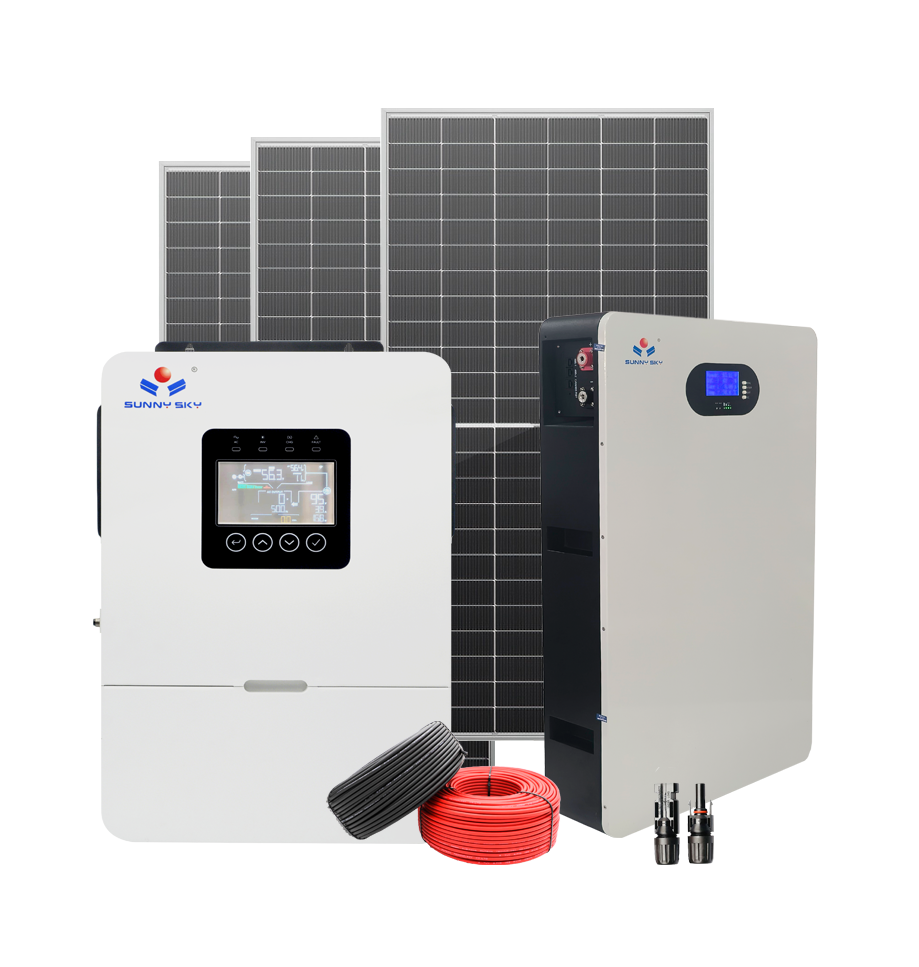
You also need to consider whether to choose a grid-connected or off-grid system. For ordinary urban households with a stable local power grid, and whose main goal is to save on electricity bills, a grid-connected system is sufficient. For remote areas, frequent power outages, or those who wish to completely disconnect from the grid, an off-grid or hybrid system is necessary, along with a sufficiently large capacity of energy storage batteries.
Conclusion
After calculating all of this, you should have a basic idea of how large a solar energy system you need for your home.
To summarize briefly: First, check your electricity bill to understand your average monthly electricity consumption; second, calculate your average daily electricity consumption and the distribution of electricity usage during different times of day; third, determine the system power based on local sunlight conditions and your own needs; and fourth, leave room for future growth.
If you're still unsure after all the calculations, here's a simple rule of thumb: 5kW is enough for an average urban family; 8 to 10kW is suitable for a villa or large apartment; and 10kW is the minimum for a three-generation family or one with central air conditioning.
Installing solar panels is a major undertaking that requires careful planning. Don't be tempted by cheap options that don't meet your needs, and don't blindly pursue high power output and waste money. Read this article a couple of times, or simply send it to someone knowledgeable to help you calculate the costs.
After all, installing the right one saves money and is environmentally friendly, while installing the wrong one will either make you regret not having enough or regret spending too much.
Please contact Simon immediately to discuss your project:
• WeChat: TY530643572
• Telephone: +86 137 1166 004