Introduction
As solar energy moves from a supplementary power source to a cornerstone of home and commercial energy strategy, the storage inverter has become the most critical — and most misunderstood — component in the system.
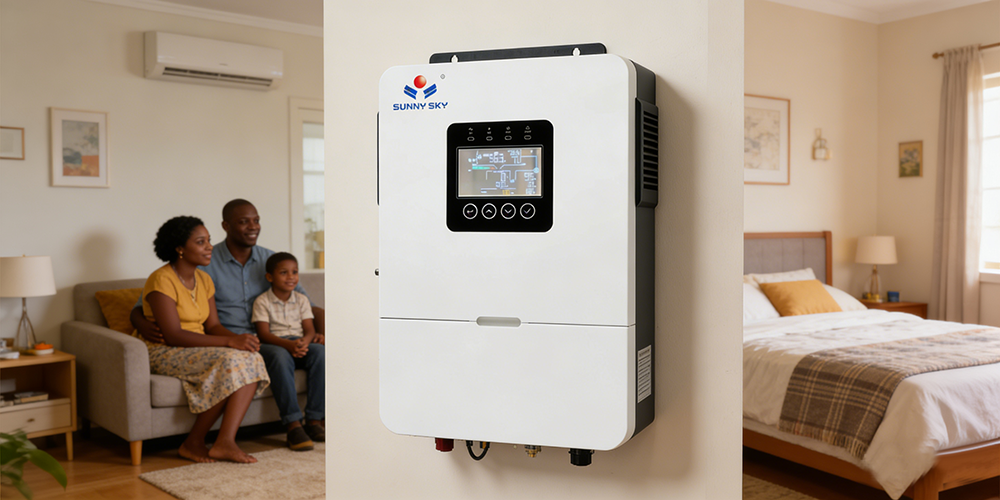
A solar storage inverter (also called a battery-based inverter or hybrid inverter) does everything a standard inverter does — converting the direct current (DC) from solar panels into alternating current (AC) for your home or facility — but it goes further. It manages battery charging and discharging, decides when to draw from the grid, when to store solar energy, and when to power your loads independently. In short, it is the brain of an energy-independent system.
Choosing the right storage inverter is not a decision you can make based on price alone. It determines how much of your solar production you actually use, how protected you are during outages, how quickly your system pays for itself, and how well it integrates with the grid, batteries, and EV chargers over the next 10–25 years.
This guide is written to help you navigate that decision clearly — and to show you why Sunnysky Solar inverters are consistently emerging as the preferred choice for installers and end users who demand high performance without unnecessary complexity.
1. What Is a Solar Storage Inverter?
A solar storage inverter is a battery-integrated inverter that manages a multi-directional energy flow:
- Solar panels → Inverter → Home loads or grid (normal daytime operation)
- Solar panels → Inverter → Battery bank (charging when production exceeds demand)
- Battery → Inverter → Home loads (nighttime or grid outage)
- Grid → Inverter → Battery (grid charging where regulations permit)
- EV charger → Inverter → Battery (vehicle-to-home in V2H capable systems)
This bidirectional capability — the ability to charge and discharge batteries, not just convert DC to AC — is what distinguishes a storage inverter from a standard grid-tied inverter. If you want energy independence, backup power, or smarter energy use, a storage inverter is not optional — it is the entire point.
2. Types of Solar Storage Inverters
2.1 Hybrid Inverter (All-in-One Storage Inverter)
How it works: A hybrid inverter handles DC-AC conversion, battery charging, and grid interaction in a single unit. Solar panels connect directly to the inverter, which manages energy flows between panels, batteries, the home, and the grid.
Best for: Homeowners and small commercial operators who want battery storage now or plan to add it in the near future. The most common choice for new residential installations.
Pros:
- Single integrated unit — simpler installation, fewer components, lower labor cost
- Intelligent energy management between solar, battery, grid, and loads
- Battery-ready without requiring a separate battery inverter
- Automatic backup switchover during grid outages (typically < 20 ms)
- Supports time-of-use optimization, self-consumption maximization, and demand response
Cons:
- Battery capacity is limited by the inverter’s charge/discharge rating
- If the inverter fails, both conversion and battery management are lost simultaneously
- Battery chemistry and capacity must be compatible with the inverter’s charging parameters
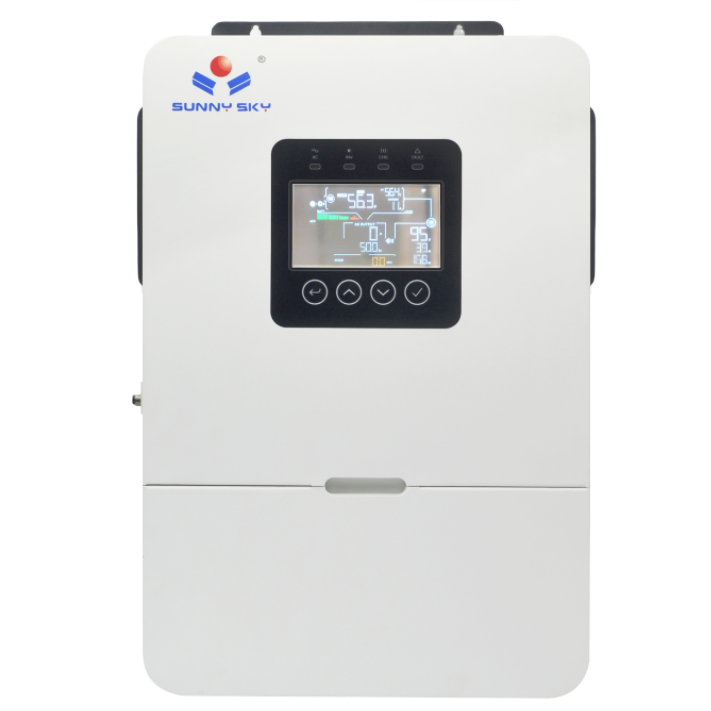
Where Sunnysky Solar fits: Sunnysky Solar hybrid inverters are engineered for this exact use case. They combine high-efficiency conversion with intelligent battery management, wide battery compatibility (LiFePO4, NMC, Lead-Acid), and built-in EPS (Emergency Power Supply) functionality — all in a single compact unit that installs in hours rather than days.
2.2 AC-Coupled Storage Inverter
How it works: An AC-coupled system adds battery storage to an existing grid-tied solar installation. The existing solar system generates AC power through its original string inverter. A separate AC-coupled storage inverter then manages battery charging and discharging independently.
Best for: Retrofitting batteries onto existing solar installations without replacing the current inverter. Ideal when homeowners want to add storage to a system that was installed without it.
Pros:
- Does not interfere with or require replacing the existing grid-tied inverter
- Scalable — add more battery capacity by adding more storage inverters
- Each component can be maintained or upgraded independently
- Works with a wide range of existing solar panel and inverter brands
Cons:
- Two-stage energy conversion (DC → AC by original inverter, AC → DC → AC by storage inverter) introduces small but measurable efficiency losses
- Requires an additional device to manage communication between the two inverters
- Higher total system cost than a single hybrid inverter for new installations
- Backup power may depend on both inverters functioning correctly
Where Sunnysky Solar fits: Sunnysky Solar also offers AC-coupled storage solutions designed for seamless integration with existing string inverter systems, providing a non-invasive path to battery storage for homeowners who already have solar panels installed.
2.3 Multi-Mode Inverter
How it works: A multi-mode inverter operates independently from the grid — it can island from the grid entirely and power loads purely from solar and battery, or connect to the grid when available. It does not require the grid to function.
Best for: Off-grid homes, remote installations, telecom base stations, rural facilities, and anyone seeking complete energy independence without any grid dependency.
Pros:
- Full grid independence — operates with or without grid connection
- Can form microgrids with multiple units
- Flexible system architecture
- Typically required for off-grid solar-plus-storage systems
Cons:
- More complex configuration and commissioning
- More expensive than hybrid inverters for grid-connected use cases
- Requires properly sized battery bank and generator backup for extended low-solar periods
Where Sunnysky Solar fits: Sunnysky Solar multi-mode inverters are built with robust off-grid capability and wide operating temperature ranges, making them a trusted choice for both remote residential off-grid installations and commercial telecom/back-up applications.
3. Key Factors in Choosing a Solar Storage Inverter
3.1 Battery Compatibility
This is the most important technical factor.
Not all inverters work with every battery type. Check that the inverter supports:
- Battery chemistry: LiFePO4 (Lithium Iron Phosphate), NMC (Nickel Manganese Cobalt), or Lead-Acid
- Voltage range: Battery bank voltage (48V, 200V, 400V class) must be within the inverter’s supported range
- Charging current: Higher charging current = faster battery replenishment after a discharge cycle
- Communication protocol: CAN bus, RS485, or Modbus — the inverter and battery must “speak the same language”
- Battery brand restrictions: Some inverters are designed to pair only with their own brand of batteries
Sunnysky Solar advantage: Sunnysky Solar inverters feature broad multi-brand battery compatibility with automatic BMS (Battery Management System) protocol detection, supporting major battery brands via CAN and RS485 interfaces. This eliminates the frustration of rigid pairing requirements and gives installers flexibility on the battery side.
3.2 Power Rating and Surge Capacity
Choose an inverter rated for your peak load — not just your average load.
| Scenario | Recommended Inverter Rating |
|---|---|
| Small home (lighting, fridge, laptop) | 3–5 kW AC output |
| Medium home (adds air conditioning, washer) | 5–8 kW AC output |
| Large home or small commercial | 8–15 kW AC output |
| Whole-home backup with EV charger | 15 kW+ AC output |
Critical specification — surge capacity: Devices like air conditioners, refrigerators, and well pumps draw 3–5× their running wattage at startup. A storage inverter with insufficient surge rating will cut off or fail to start these loads during an outage. Look for an inverter that can handle 1.5× to 2× its rated continuous power for at least 5–10 seconds.
Sunnysky Solar advantage: Sunnysky Solar inverters deliver industry-leading surge capacity, sustaining up to 2× rated power for 10 seconds and 1.5× for 60 seconds. This ensures that demanding appliances — including hard-start air conditioning units — start reliably during grid outages without needing an oversized battery bank.
3.3 Efficiency
Efficiency determines how much of your solar and battery energy you actually get to use.
- CEC (California Energy Commission) weighted efficiency: The most realistic efficiency metric — measures performance across a typical day’s operating conditions. Look for 96% or above for high-quality storage inverters.
- Maximum (peak) efficiency: Often quoted in marketing materials. Less realistic but useful for comparing two models. Look for 97–98%+.
- Battery round-trip efficiency: A measure of how much energy is lost during a charge-discharge cycle. High-quality LiFePO4 systems achieve 90–95% round-trip efficiency.
Sunnysky Solar advantage: Sunnysky Solar inverters achieve CEC-weighted efficiency exceeding 96.5% and peak efficiency of 97.8%, placing them among the highest-efficiency inverters in their power class. This translates directly into more usable energy per dollar of solar production.
3.4 Backup Performance (EPS / UPS Functionality)
If you want power during outages, the quality of your backup function is critical.
EPS (Emergency Power Supply): Entry-level backup — switches to battery power within 10–100 ms. Sufficient for lights and electronics; may not handle inductive loads like air conditioners without interruption.
UPS (Uninterruptible Power Supply): High-quality backup — switches in < 20 ms, typically undetectable to sensitive electronics. Required if you want seamless backup for computers, medical equipment, or server rooms.
Whole-home vs. partial-home backup: Some inverters can power the entire home; others can only power a dedicated backup subpanel. Verify this before purchasing.
Sunnysky Solar advantage: Sunnysky Solar inverters deliver true UPS-grade EPS performance with sub-20ms switchover, pure sine wave output, and balanced phase loading in three-phase models — ensuring sensitive electronics and air conditioning compressors restart reliably after grid loss. Their EPS mode operates without any grid dependency, providing true islanding protection.
3.5 Solar Input Capacity (DC String vs. MPPT Channels)
The inverter’s solar input capacity determines how much panel capacity you can connect and how flexibly you can configure your array.
- Number of MPPT channels: More MPPT channels = more flexibility with multiple roof orientations. Two MPPTs cover most residential roofs; three or four are needed for complex commercial layouts.
- Maximum DC input voltage: Higher max input voltage allows longer strings (more panels per string), reducing DC cable costs.
- Operating voltage range: Wider MPPT range = more harvest across varying conditions (temperature changes, partial shading).
Sunnysky Solar advantage: Sunnysky Solar inverters feature dual or triple independent MPPT trackers with ultra-wide MPPT operating windows (150V–550V or 200V–800V depending on model), enabling flexible string design across diverse roof configurations. Maximum DC input capacity typically exceeds AC output rating by 20–30%, capturing more of your panel potential.
3.6 Smart Features and App Integration
Modern storage inverters are smart devices. The quality of their monitoring and control features matters for both day-to-day use and long-term system optimization.
Key smart features to look for:
- Real-time monitoring app: View solar production, battery state of charge, home consumption, grid export/import, and historical data
- Time-of-use (TOU) scheduling: Automatically charge batteries from solar during off-peak hours and discharge during peak-rate periods to maximize bill savings
- Export limit control: Cap or eliminate grid export if your utility does not offer favorable net metering
- Generator integration: Automatically start a backup generator when battery is low and solar is insufficient (critical for off-grid and extended outage scenarios)
- Firmware updates: Over-the-air or app-based updates keep your inverter current with new features and standards
Sunnysky Solar advantage: Sunnysky Solar inverters come with a dedicated smart monitoring app that provides real-time system visibility, TOU scheduling, export limit control, and remote firmware updates. Installer-level configuration tools allow certified partners to optimize system parameters for each specific installation.
3.7 Warranty and Technical Support
Storage inverters are long-term investments. A 10-year warranty is standard in the industry; premium products offer 10–12 years.
Warranty considerations:
- What is covered: full unit replacement, or repair with shipping costs?
- Is labor included, or only the product?
- Does the warranty transfer to a new homeowner (important if you sell your house)?
- What is the manufacturer’s track record for honoring warranties?
Sunnysky Solar advantage: Sunnysky Solar provides a comprehensive 10-year product warranty with a network of regional service centers, rapid RMA processing, and dedicated installer support. Their technical team has a reputation for responsive, solutions-oriented support — a significant advantage over brands that offer long warranties but slow service.
4. Sunnysky Solar: Why It Stands Out
While the market is crowded with storage inverter brands, Sunnysky Solar has built a differentiated position by focusing on the technical and practical priorities that matter most to installers and end users — rather than marketing volume or brand legacy.
4.1 High Efficiency Across All Operating Conditions
Sunnysky Solar inverters are engineered for real-world performance, not just datasheet specifications. Their proprietary MPPT algorithm continuously adapts to rapidly changing irradiance conditions (passing clouds, shade transitions), extracting maximum energy throughout the day. With CEC-weighted efficiency exceeding 96.5%, users consistently report energy yields 2–5% higher than comparable inverter models in the same installation.
4.2 Outstanding Surge and Load Handling
Sunnysky Solar’s generous surge capacity design is one of its most praised features. During grid outages, homeowners using air conditioning, well pumps, or electric vehicle charging need headroom — and Sunnysky delivers it. The 2× / 10-second surge rating and 1.5× / 60-second rating comfortably exceed the specifications of most competing inverters in the same power class.
4.3 Universal Battery Compatibility
Unlike brands that lock you into proprietary battery systems, Sunnysky Solar inverters work with virtually any LiFePO4, NMC, or lead-acid battery bank from major manufacturers. The automatic BMS protocol detection reduces installation time and eliminates configuration errors that can occur with manual settings.
4.4 Robust Build Quality
Sunnysky Solar inverters are built with industrial-grade components and conformal-coated circuit boards that resist moisture and dust — a critical factor in rooftop-adjacent installations, garages, and outdoor enclosures. Operating temperature ranges extend from -25°C to +60°C, ensuring reliable operation in both cold northern climates and hot desert environments.
4.5 Installer-Friendly Design
Sunnysky Solar has clearly designed their products with the installer in mind:
- Tool-free wiring terminals and clear terminal labeling
- Integrated DC disconnects on select models
- Compact form factor with flexible mounting orientation
- Comprehensive commissioning software with automated parameter validation
- Multi-language LCD display and app interface
4.6 Competitive Total Cost of Ownership
Sunnysky Solar achieves premium performance at a mid-market price point. When you factor in:
- Higher energy harvest from superior MPPT and efficiency
- Lower battery system cost due to multi-brand compatibility
- Faster installation from installer-friendly design
- Reliable warranty support reducing long-term service costs
…total cost of ownership is among the most competitive in the industry.
5. Matching an Inverter to Your Situation
Scenario 1: New solar-plus-storage installation, grid-connected, south-facing roof
→ Sunnysky Solar Hybrid Inverter. The most cost-effective choice for new installations. Handles all energy flows intelligently, provides UPS-grade backup, and is ready for battery integration from day one.
Scenario 2: Adding battery storage to an existing solar system (retrofit)
→ Sunnysky Solar AC-Coupled Storage Inverter. Preserve your existing string inverter and add battery capability without replacing it. The AC-coupled Sunnysky unit integrates cleanly with your current setup.
Scenario 3: Off-grid home or cabin, no grid connection available
→ Sunnysky Solar Multi-Mode Inverter + Generator Integration. Full energy independence with automatic generator start when battery reserve is low. Properly sized battery bank ensures multi-day autonomy.
Scenario 4: Small commercial installation, 15–30 kW, partial backup required
→ Sunnysky Solar Three-Phase Hybrid Inverter. Supports three-phase loads, large battery banks, multiple MPPT inputs, and provides whole-site or critical-load backup.
Scenario 5: Energy-conscious homeowner with time-of-use electricity rates
→ Sunnysky Solar Hybrid Inverter with TOU Scheduling. Configure the inverter to charge the battery from excess solar during the day and discharge during peak rate hours. In many utility territories, this strategy shaves 30–60% off electricity bills.
6. Common Mistakes to Avoid
Mistake 1: Choosing an Inverter Based on Panel Capacity Alone
A storage inverter must be sized for both solar input and load output — these are two separate considerations. Undersizing the inverter relative to your loads is the most common and most consequential sizing error.
Mistake 2: Ignoring Battery Round-Trip Efficiency
An inverter with poor battery charge/discharge efficiency will waste 10–15% of every cycle. Over a 10-year battery lifespan, this adds up to thousands of kilowatt-hours lost. Sunnysky Solar’s high-efficiency charging circuitry minimizes this loss.
Mistake 3: Not Verifying Backup Load Compatibility
An inverter rated at 10 kW does not necessarily mean it can start a 3 kW air conditioner. Check the surge rating and inrush current specifications for every load you plan to run on backup power.
Mistake 4: Selecting a Proprietary Battery System
Proprietary batteries may look convenient but limit your options, increase replacement costs, and create dependency on a single vendor. Sunnysky Solar’s open battery compatibility eliminates this risk.
Mistake 5: Overlooking Grid Regulation Compliance
Different countries and utility territories have different technical requirements for grid-tied inverters (e.g., IEEE 1547 in the US, VDE-AR-N 4105 in Germany, AS 4777 in Australia). Verify that the inverter is certified for your specific grid region.
Mistake 6: Skipping the Monitoring Setup
A storage system without monitoring is a black box. You will not know if a battery cell is failing, if a string of panels is underperforming, or if your system is producing below expectations. Configure monitoring during installation — it takes 10 minutes and saves years of missed performance.
7. Quick Reference: What to Check Before You Buy
| Specification | What to Look For | Sunnysky Solar Performance |
|---|---|---|
| CEC efficiency | ≥ 96% | 96.5%+ |
| Peak efficiency | ≥ 97% | 97.8% |
| Surge capacity | 1.5–2× rated for 5–60 seconds | 2× / 10s, 1.5× / 60s |
| MPPT channels | 2+ for residential, 3+ for complex | Dual/Triple MPPT |
| Battery compatibility | Multi-brand LiFePO4/NMC/Lead-Acid | Auto-BMS detection, CAN + RS485 |
| EPS switchover | < 20 ms for UPS grade | < 20 ms |
| Operating temp range | -20°C to +55°C minimum | -25°C to +60°C |
| Warranty | 10 years standard | 10 years |
| App monitoring | Real-time, historical, TOU | Yes — dedicated smart app |
| Grid certifications | Local grid standard required | Certified for major global markets |
8. Conclusion
Choosing a solar storage inverter is ultimately about choosing how you interact with your own energy — when you use it, when you store it, and how protected you are when the grid fails.
There is no single right answer for everyone, but there are clearly better and worse decisions based on your specific situation. Work through the factors in this guide systematically:
- Assess your needs — grid backup, off-grid, time-of-use savings, EV integration
- Check battery compatibility — ensure your preferred battery works with the inverter
- Verify surge and load ratings — your inverter must handle your peak demand, not just average load
- Prioritize efficiency — every percentage point of efficiency is free energy over 10+ years
- Choose a brand with strong support — warranty claims and technical support matter when issues arise
Sunnysky Solar inverters check every one of these boxes — high efficiency, robust surge capacity, broad battery compatibility, reliable backup performance, and a 10-year warranty backed by responsive technical support. For installers and homeowners who want a high-performance storage inverter without the complexity or proprietary lock-in of more expensive alternatives, Sunnysky Solar is a choice worth serious consideration.