1. In Africa, Electricity Is an “Intermittent Service”
In many African countries, the question isn’t whether you have power — it’s when you have it. Hotel owners know the scene too well: a guest walks into the room, switches on the AC, the lights flicker twice… and then the whole building goes dark. Another blackout.
The grid electricity price — about $0.21/kWh (CNY 1.5/kWh) — sounds reasonable on paper. But when the grid fails, hotels have no choice but to fire up diesel generators. And diesel doesn’t just burn fuel — it burns money. When you factor in diesel, oil, and maintenance, the cost per kilowatt-hour easily doubles. Guests don’t pay less just because you lost power, but your electricity bill quietly grows every time the generator runs.
2. How Much Power Does This Hotel Actually Use?
This is a small boutique hotel with 10 guest rooms. Each room is equipped with: 1 air conditioner, 1 TV, 1 small refrigerator, lighting fixtures, and power outlets for guest device charging.
Based on typical power ratings and daily usage hours, each room consumes approximately 10 kWh per day. Ten rooms means 100 kWh — plus common areas like the front desk, lobby, kitchen, water pump, and staff quarters. Total daily consumption: approximately 100 kWh.
Before the upgrade, about 70% of this 100 kWh came from the grid, and 30% was covered by diesel generators during outages. At CNY 1.5/kWh (grid) and CNY 2.5/kWh (diesel, estimated), the hotel was spending roughly CNY 180 per day, or CNY 65,700 per year on electricity.
3. The System: $10,000 to Build a Small Solar Power Station
Here’s the actual solar system the user deployed:
| Component | Specification | Quantity |
|---|---|---|
| Solar Panels | 600W/panel | 40 panels (24kWp total) |
| Inverters | 12kW | 3 units (36kW total) |
| LiFePO4 Battery | 16kWh/unit | 4 units (64kWh total) |
| Mounting & Accessories | — | Full system |
| Total System Cost | ~$10,000 USD (≈ CNY 70,000) |
How much power does this system generate?
Africa enjoys abundant sunlight. Taking 5.5 peak sun hours per day and a system efficiency factor of 0.8:
24kWp × 5.5h × 0.8 = ≈ 106 kWh/day
This essentially covers the hotel’s 100 kWh daily load. On sunny days, solar handles everything. At night and during overcast weather, the batteries take over. The 64 kWh battery bank can sustain full load for approximately 15 hours — enough for a typical cloudy day. Only in cases of prolonged extreme weather would the diesel generator need to kick in for backup.
4. Cost Comparison: Three Scenarios Side by Side
| Scenario | Daily Cost | Monthly Cost | Annual Cost (CNY) | Annual Cost (USD) |
|---|---|---|---|---|
| Scenario 1: Grid Only | 100 × CNY 1.5 = CNY 150 | CNY 4,500 | CNY 54,750 | $7,821 |
| Scenario 2: Grid + Diesel (30% outage time) | 70 × CNY 1.5 + 30 × CNY 2.5 = CNY 180 | CNY 5,400 | CNY 65,700 | $9,386 |
| Scenario 3: Solar-Dominant (battery + diesel backup) | ≈ CNY 36 | ≈ CNY 1,080 | ≈ CNY 13,000 | ≈ $1,857 |
Scenario 3 notes: Solar covers approximately 90% of daily consumption. During extreme overcast conditions when batteries are depleted, a small diesel top-up (~2–3 kWh/day) supplements the shortfall. LiFePO4 batteries have a lifespan of approximately 10 years; replacement cost for 4 units of 16kWh is estimated at CNY 12,000, averaging CNY 1,200/year.
5. Return on Investment: The Numbers
| Comparison Baseline | Annual Savings | Payback Period |
|---|---|---|
| vs Grid Only (Scenario 1) | CNY 54,750 − CNY 13,000 = CNY 41,750/year (~$5,964) | ≈ 1.7 years |
| vs Grid + Diesel — Real-World (Scenario 2) | CNY 65,700 − CNY 13,000 = CNY 52,700/year (~$7,529) | ≈ 1.3 years |
10-Year Cumulative Net Gain (after battery replacement ~CNY 12,000):
| Comparison Baseline | 10-Year Total Savings | Net Profit After $10,000 Investment |
|---|---|---|
| vs Grid Only | CNY 417,500 − CNY 12,000 = CNY 405,500 | ~$56,500 |
| vs Grid + Diesel | CNY 527,000 − CNY 12,000 = CNY 515,000 | ~$73,500 |
In plain terms: Spend $10,000 once, earn $50,000–$75,000 over the next 10 years.
6. The Invisible Ledger: It’s Not Just About Electricity Bills
Beyond the direct numbers, this system delivers value that’s harder to quantify:
- Stable guest experience. No more blackouts meaning no AC, no TV, no Wi-Fi. Review scores and repeat bookings quietly climb.
- Peace of mind for the owner. No more monitoring the generator around the clock, no more midnight trips to refuel.
- Immunity to diesel price spikes. When international oil prices rise, generator costs rise with them. Solar’s marginal cost is always zero.
- A marketing edge. In Africa, advertising “solar-powered, reliable electricity” is itself a competitive advantage that attracts conscious travelers and business guests.
7. Conclusion
Switching energy sources is never just about saving money.
For this small African hotel, the first gift of solar power is certainty — lights that don’t flicker, AC that doesn’t cut out, guests who don’t frown.
When sunlight starts paying your electricity bill, your business is finally in your own hands.
Spending $10,000 today buys freedom — the freedom of saving $5,000–$7,000 every year for the next decade.
Calculation Notes
- Per-room load estimate: AC 1.0kW×8h + TV 0.1kW×4h + Refrigerator 0.1kW×24h + Lighting 0.02kW×8h + Outlets 0.05kW×4h ≈ 10 kWh/room/day
- Total hotel load: 10 rooms × 10 kWh + common areas ≈ 100 kWh/day (confirmed by user)
- Scenario 2 (30% outage time via diesel): diesel blended cost estimated at CNY 2.5/kWh (fuel, oil, maintenance)
- Solar generation: 24kWp × 5.5h × 0.8 = 105.6 kWh/day (5.5 peak sun hours, typical for high-insolation African regions)
- Battery capacity: 64 kWh, covering ~15 hours full-load or a typical overcast day
- Battery replacement estimate at year 10: 4 units × CNY 3,000 ≈ CNY 12,000
- Exchange rate: 1 USD ≈ 6.7 CNY
Why hotel operators in Africa are taking solar seriously
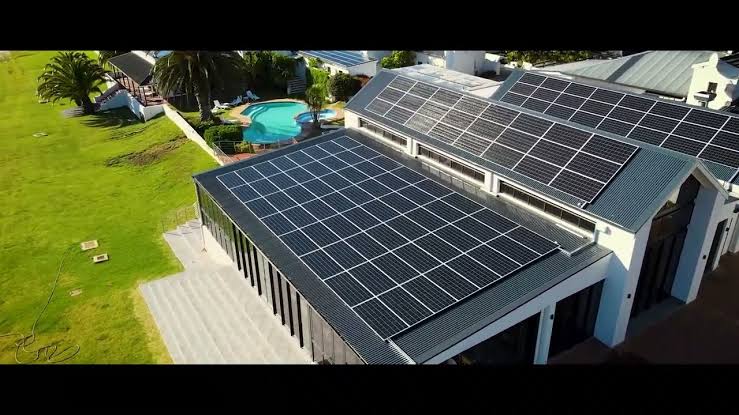
A solar power system for hotels in Africa is no longer just a green upgrade; for many properties it is a practical answer to unstable grids, rising diesel costs, and guests who expect uninterrupted comfort. A hotel cannot afford to lose power in the middle of a check-in rush, a dinner service, or a full house on a hot night. That is why more owners, engineers, and procurement teams are comparing solar options as part of core building infrastructure rather than treating them as a side project.
The real decision is not whether solar works in principle. It is which setup fits the property: a hotel solar power system that leans on the grid, a hybrid solar power system for hotels with battery backup, or an off-grid solar for hotels Africa solution where utility service is weak or absent. Each path solves a different problem, and choosing the wrong one can leave a hotel with either unnecessary cost or too little resilience.
The hotel power problem: cost, reliability, and guest experience
Hotels use electricity in a very uneven way. Early mornings bring water heating and kitchen demand. Midday often means laundry, cooling, and circulation loads. Evenings pull hard on lighting, reception, lifts, and room air conditioning. If power fails during any of those peaks, the damage is not limited to the utility bill. It affects reviews, staff workload, and maintenance schedules.
In many markets, renewable energy for hotels in Africa is attractive because it can offset daytime consumption while reducing dependence on generators. A rooftop solar array can cover a meaningful share of common-area loads and, when paired with storage, help ride through outages or peak tariff periods. That said, solar is not a magic replacement for good electrical planning. Hotels still need load profiles, proper switching logic, and a realistic view of how much backup time they actually require.
Quick comparison: which hotel solar model fits?
Grid-tied systems
A grid-tied solar for hotels Africa setup works best where utility supply is stable enough to remain connected, and where the goal is bill reduction rather than full independence. It is usually the simplest arrangement, but it offers limited protection when the grid is down unless it includes backup functions.
Hybrid systems
Hybrid solar power systems for hotels combine solar generation with batteries and grid support. For most hospitality properties, this is the most balanced option because it can shave daytime demand, charge storage, and keep essential loads running during short outages. The trade-off is cost and system complexity. Controls, battery sizing, and maintenance matter a great deal here.
Off-grid systems
Off-grid solar for hotels Africa makes sense for remote resorts, island properties, or sites where utility power is unreliable to the point of being unusable. These systems need careful engineering. If the battery bank is undersized, the hotel may still end up running a generator when occupancy rises or weather cuts solar output. In hospitality, that defeats part of the purpose.
What to look for in a solar PV system for hospitality
A solar PV system for hospitality should be judged on more than panel count. Rooftop space, roof orientation, shading from trees or adjacent buildings, and available electrical room space all influence performance. A facility may have a large roof, but if the roof is broken into many sections or partially shaded, the usable area drops fast.
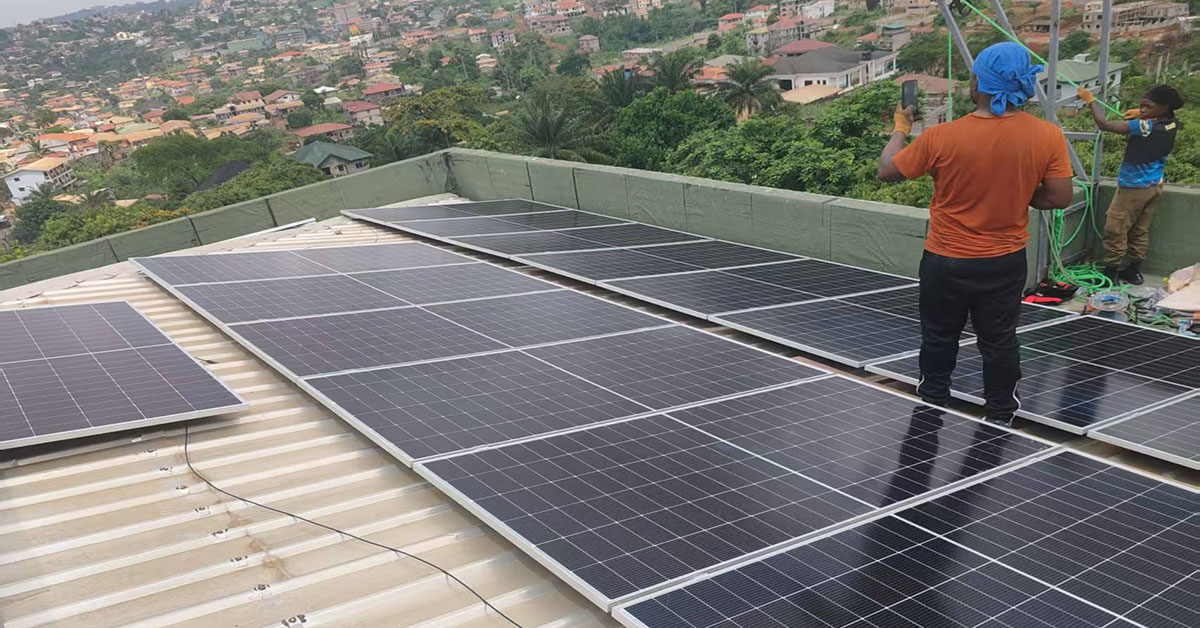
The equipment itself also matters. Standard framed crystalline-silicon panels are common in rooftop installations, mounted on metal-clad roofs or other commercial surfaces. For hotels, the practical question is not simply how many modules fit, but how the system integrates with inverters, batteries, and the building’s distribution board.
For storage, cabinet-style battery energy systems are increasingly relevant. A modular floor-standing battery rack with a front display, labeled terminals, and service access is easier to manage than a loose assembly of components. Still, buyers should insist on complete technical documentation before they compare models. Battery chemistry, capacity, cooling method, and protection features are not details to gloss over.
Common mistakes buyers make
The first mistake is oversizing the solar array while undersizing the battery or inverter side. Hotels often need energy after sunset, not just during the day. The second mistake is assuming that all roof space is equally usable. It is not. Sloped metal roofs with ridges, flashings, vents, and service obstructions can reduce the practical installation area.
Another common issue is buying equipment before the hotel has settled its operational priority: savings, backup, or independence. Those are related goals, but they are not identical. A property trying to cut costs may choose a different architecture from a resort that must stay open through long outages. The purchasing path should follow the duty cycle, not the brochure.
Buyer advice before requesting quotes
Start with a simple energy audit. Separate critical loads from flexible loads. Reception lighting, network equipment, security systems, and selected room circuits are usually priority loads. Laundry, kitchen, and water pumping may need different treatment depending on operating hours.
Ask suppliers for a system layout that shows panel placement, inverter arrangement, battery cabinet location, and how changeover will work during outages. If the supplier cannot explain these basics in plain language, keep looking. Guangzhou Tianyuan Solar Equipment CO.,LTD, for example, positions its SUNNYSKY brand around reliability, R&D, and international supply, and notes factory access near Guangzhou Baiyun International Airport for visiting clients. That kind of supplier visibility can be useful, but the final decision should still rest on the technical proposal, not the sales pitch.
Also be careful with overly neat promises. A hotel solar project is a building project, an electrical project, and an operations project at the same time. If any one of those pieces is ignored, the payback story gets messy.
What a good first conversation with a supplier should cover
Before you approve a hotel solar power system, ask about load profile assumptions, storage strategy, roof structure checks, maintenance access, and how the system will behave when occupancy rises. If your site is remote, ask specifically about backup duration and generator integration. If your site is urban and grid-connected, ask how much daytime demand can realistically be offset and whether the system supports self-consumption first.
For procurement teams, the best outcome is usually a phased approach: define critical loads, verify roof viability, choose the right operating model, then compare hardware and installation packages. That sequence keeps the project grounded in hotel operations rather than in abstract kilowatt-hour targets.
FAQ
Is solar suitable for all hotels in Africa?
Not in the same way. Urban business hotels, safari lodges, coastal resorts, and remote eco-properties all have different load patterns and outage exposure. The system should match the property type.
Do hotels need batteries?
Not always, but many do benefit from them. If outages are frequent or guest comfort cannot tolerate interruptions, batteries become much more valuable.
Can rooftop solar cover a hotel’s full demand?
Sometimes, but not always. Roof area, shading, and night-time consumption often limit how far solar can go without storage or supplemental power.
Next step
If you are planning solar energy for hotels Africa, begin with a site review and a load audit, then request a system design that separates generation, storage, and backup functions clearly. That is the fastest way to compare suppliers on something more solid than generic promises and to choose a system that supports the hotel, not just the roof.