If you install solar in Nigeria, Kenya, Zambia, Cameroon, or almost anywhere in sub-Saharan Africa, you already know the uncomfortable truth: the inverter you specify is not really being tested against a datasheet. It is being tested against a grid that sags to 170V in the afternoon, spikes past 260V when a transformer switches, drops to 47Hz, and disappears entirely for six hours without warning.
Most inverter failures in Africa are not manufacturing defects. They are mismatches between a product designed for a stable European grid and a reality where the grid is the least stable part of the system.
This article looks at one specific technical question that decides whether a hybrid solar inverter survives in these conditions: how does MPPT performance actually behave when input voltage and grid voltage are both moving constantly? And what should you check before you buy?
What “Weak Grid” Actually Means — In Electrical Terms
“Unstable power” is a vague phrase. When engineers specify a hybrid solar inverter for African conditions, they are usually dealing with five measurable problems:
| Grid Condition | Typical Range in Weak-Grid Africa | Why It Hurts the Inverter |
|---|---|---|
| Voltage sag (brownout) | 170–200V where 230V is nominal | AC charger works harder, current rises, heat increases |
| Voltage swell | 250–270V spikes | Over-voltage trip, or stress on input capacitors |
| Frequency deviation | 47–52Hz | Grid-tie sync fails, inverter refuses to connect |
| Frequent outages | 2–10 events per day | Repeated switching cycles, relay wear, restart stress |
| High harmonics / poor waveform | THD often above 8% | Distorted AC input degrades charging and sensing accuracy |
A hybrid solar inverter built for a European grid assumes all five of these are rare exceptions. It is designed to disconnect and wait. In Africa, disconnecting is not an acceptable response — the load still needs power. The inverter has to ride through, not shut down.
That single difference in design intent separates a product that lasts five years in Lagos from one that fails in fourteen months.
Why Voltage Fluctuations Break Ordinary Inverters
A grid-tied inverter’s job is simple: match the grid, inject power, disconnect on abnormality. A hybrid solar inverter has a much harder job: manage four energy sources at once — solar, battery, grid, and generator — while the grid itself is misbehaving.
Three failure mechanisms show up repeatedly in the field:
1. AC charging from a bad grid destroys batteries slowly. When grid voltage sags, a fixed-voltage charger pulls more current to maintain charge power. That current heats the charge circuit and stresses the battery. If the charger does not adapt its voltage and current limits to the actual input, a battery that should last 6,000 cycles can degrade noticeably within two years. This is one of the most common — and least diagnosed — causes of early lithium battery failure in West Africa.
2. Relay and switching components wear out from repeated cycling. Two to ten outages per day means two to ten transfer cycles per day. Over a year, that is thousands of switching events. Inverters with undersized transfer relays or slow switching logic develop welded contacts and failed transfers. A hybrid solar inverter designed for weak-grid duty uses faster transfer logic and components rated for high cycle counts — typically quoted as a transfer time under 10ms, which also protects sensitive loads like fridges, pumps, and medical equipment.
3. Sensing accuracy drifts under distorted waveform. Protection logic depends on accurate voltage and frequency measurement. High-THD grids confuse cheap sensing circuits, leading to false trips (nuisance shutdowns) or, worse, failure to trip when a real fault occurs. This is a safety issue, not just an inconvenience.
How MPPT Performance Changes Under Unstable Voltage
This is the part most buyers never ask about — and the part that most affects real energy yield.
MPPT (Maximum Power Point Tracking) is the function that constantly adjusts the operating point of the solar array to extract maximum power. On a stable grid with stable irradiance, almost any MPPT algorithm performs well. Under African conditions, three factors separate good from mediocre.
The MPPT Voltage Window Is the First Filter
Every hybrid solar inverter has a specified MPPT operating range — for example, 60–500V. Panels only produce usable power inside that window. When the array voltage falls below the lower limit (early morning, heavy cloud, high heat reducing panel voltage), the MPPT stops tracking and the system loses production silently.
In hot climates this matters more than the datasheet suggests. Panel voltage drops as cell temperature rises. A string that produces 380V at 25°C may produce only 300V at 65°C cell temperature. If the MPPT window is narrow, the array spends part of every hot afternoon outside the tracking range. A wide MPPT range keeps the array productive across heat, cloud, and low-light conditions.
This is why a wide MPPT window — not just a high maximum PV input — is one of the specifications worth comparing line by line.
Tracking Speed vs. Slow Voltage Drift
MPPT algorithms differ in how fast they respond to changing conditions. Two failure modes appear in weak-grid installations:
- Too slow: The algorithm cannot keep up with rapidly changing irradiance (fast-moving cloud), so the operating point sits below the true maximum power point for extended periods. Yield loss is invisible — the system works, it just produces less.
- Too aggressive: The algorithm reacts to every small fluctuation, oscillating around the maximum power point and never settling. This reduces average yield and can cause unstable battery charging current.
A well-tuned hybrid solar inverter balances both: fast enough to follow real irradiance changes, damped enough to ignore noise.
Multiple MPPTs Matter More Than You Think
In weak-grid markets, arrays are often installed on real roofs — different orientations, partial shade from a water tank, one string on a wall that gets afternoon shade. A single-MPPT inverter forces all strings to operate at one compromise voltage, so the shaded string drags down the whole array.
A hybrid solar inverter with dual MPPT (or more) tracks each string independently. For a roof with mixed orientation or unavoidable shading, dual MPPT typically recovers a meaningful share of the production that a single-MPPT unit loses — and it also gives the installer far more freedom in string design when roof space is irregular.
What a Hybrid Solar Inverter Must Do in a Weak-Grid Market
Based on what installers across Africa report as the make-or-break requirements, here is the practical checklist:
1. Wide AC input tolerance. The inverter should accept deeply sagged voltage without tripping to fault. Ask for the actual AC input range, not just “wide range.”
2. Fast transfer time. Under 10ms keeps most loads running through a switchover. Slower than 20ms and computers, fridges, and pumps will drop.
3. Generator input that actually works. Many African sites run a diesel generator as backup. The hybrid solar inverter must accept generator input, handle dirty generator waveforms, and manage generator + solar + battery priority correctly. This is a common gap — “generator compatible” on a brochure often means “you can connect it,” not “it will manage it well.”
4. Adaptive AC charging. Charging current and voltage must adapt to actual grid conditions, not assume a clean 230V supply. This protects the battery bank and is the single most overlooked specification.
5. High continuous and surge output. Pumps, compressors, and air conditioners have starting currents several times their running load. Undersized surge capability causes overload trips on exactly the loads customers care about most.
6. Thermal design that survives 45°C ambient. Most inverters derate above 40°C. In a metal container or unventilated room in West Africa, internal temperatures run well above ambient. Look for the derating curve, not just the maximum operating temperature claim.
7. Dust and humidity protection. Detachable dust covers, sealed cable entries, and proper IP-rated enclosures matter more than an IP number on a spec sheet — check the actual construction.
Blackout Behavior: What Happens in the First 10 Milliseconds
A hybrid solar inverter in Africa spends a large share of its life in transition. What happens during that transition determines whether the customer notices the outage at all.
- Under 10ms: Most equipment keeps running. Lights may flicker momentarily. This is the target for residential and small commercial backup.
- 10–20ms: Computers and sensitive electronics may reboot. Fridges typically ride through.
- Over 20ms: Motors stall, pumps trip, anything with a control board restarts.
The second behavior that matters is anti-islanding. When the grid goes down, the inverter must not back-feed the network — this protects utility workers. But aggressive anti-islanding logic causes nuisance disconnects in weak grids where voltage frequently dips without a true outage. A hybrid solar inverter tuned for weak-grid operation distinguishes between a sag and a genuine outage rather than treating both as a fault.
Battery Charging From an Unstable Grid
This deserves its own section because it is where the money is lost.
When you charge a lithium battery from a fluctuating grid, three things go wrong if the charger is not adaptive:
- Over-voltage at the battery terminals during grid swell — stresses the BMS and shortens cell life
- Charge current exceeding safe limits during sag — overheating and accelerated degradation
- Incomplete charging cycles — the battery never reaches full charge, so it never performs cell balancing, and capacity drifts down over months
A hybrid solar inverter with proper lithium activation and adaptive charging logic manages all three: it caps charge current based on actual input conditions, communicates with the battery BMS over CAN or RS485 to read real state of charge and temperature, and finishes the charge cycle properly so balancing can occur.
If your supplier cannot explain how their inverter handles charging during a brownout, that is a warning sign worth taking seriously.
Sizing a Hybrid Solar Inverter for Weak-Grid Conditions
Sizing for a weak grid is not the same as sizing for a stable one. Three adjustments matter:
Size the inverter above the calculated load. In a stable-grid market you can size close to peak load. In Africa, running an inverter near its limit every day, in high heat, with constant switching, is how you get early failure. Leave 20–30% headroom.
Size the battery for autonomy, not just for nightly consumption. If outages last 6 hours and occur during peak load hours, the battery must cover that entire period plus margin. Load shedding schedules are unpredictable — design for the worst realistic case.
Size the PV array to recover the battery daily even in poor conditions. If the array only produces enough on clear days, the battery never fully recharges during cloudy periods, and the system progressively loses usable capacity. Oversizing PV relative to battery is usually the right call in weak-grid markets.
Common Selection Mistakes
Choosing on rated power alone. Two 10kW hybrid solar inverters can behave completely differently if their MPPT range, AC input tolerance, surge capability, or charge logic differ.
Ignoring phase configuration. Installing a three-phase inverter on a single-phase supply — or the reverse — is a frequent and expensive error. Confirm the site’s actual supply before ordering.
Treating “generator compatible” as sufficient. Ask specifically how the inverter prioritizes generator vs. solar vs. battery, and whether it can limit generator draw to avoid overloading a small genset.
Skipping installation settings. Many systems fail because the inverter was left on default settings that assume a stable grid. Parameters for grid tolerance, charge current, and transfer thresholds must be configured for local conditions.
Not confirming the documentation. Certification (IEC 62109 for inverter safety, IEC 62619 for the battery, UN38.3 for transport) plus local import requirements — KEBS in Kenya, SONCAP in Nigeria, NRCS in South Africa — decide whether your container clears customs.
How SunnySky Solar Hybrid Inverters Address These Conditions
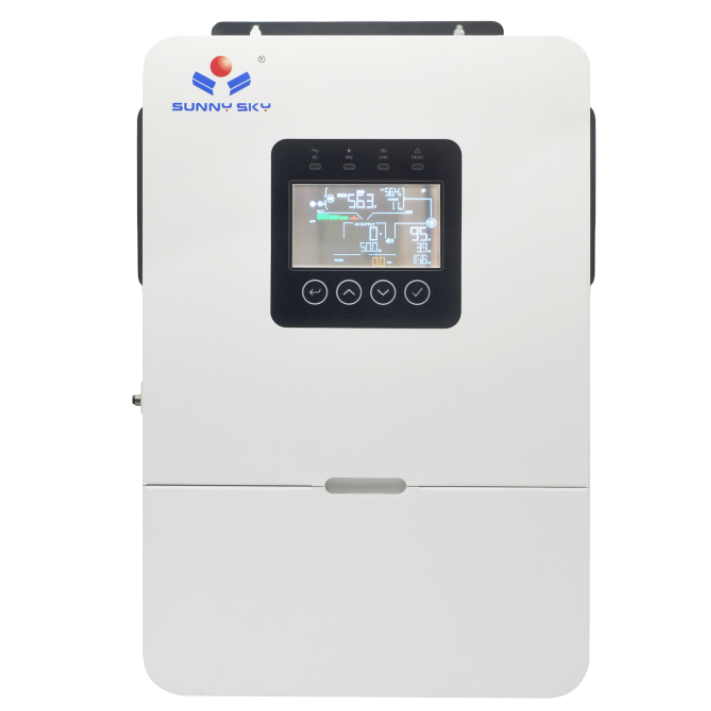
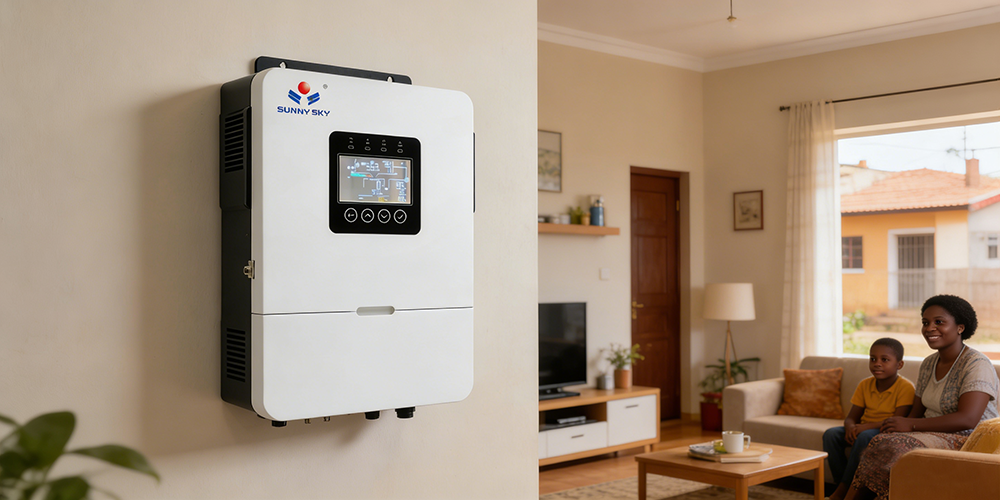
SunnySky Solar (Guangzhou Tianyuan Solar Equipment Co., Ltd.) builds hybrid solar inverters and LiFePO4 battery systems specifically for markets where the grid cannot be trusted. The specifications that matter for weak-grid Africa line up directly with the checklist above:
- Wide MPPT range (60–500V) — keeps the array inside the tracking window across high heat, cloud, and low-light hours, where narrow-window inverters silently stop producing
- Built-in 120A solar charger — integrated MPPT charging without external controllers, reducing failure points and wiring complexity on site
- Generator input support — designed to work with diesel backup, which is standard practice on African commercial and off-grid sites
- Lithium and lead-acid compatibility with lithium activation — supports both chemistries, so distributors can serve legacy lead-acid customers and new LiFePO4 installations from one product line
- Pure sine wave output — safe for pumps, compressors, fridges, and electronics with control boards
- Detachable dust cover and monitoring support — practical protection for dusty installations and remote visibility for distributors managing systems across multiple sites
- Complete CE certification support with documentation package
The company has 15+ years of experience in the solar and energy storage industry, operates its own factory in Baiyun District, Guangzhou (20 minutes from Baiyun International Airport, with complimentary pickup for visiting buyers), and has exported to over 50 countries with 360+ corporate clients across Africa, South America, Southeast Asia, Eastern Europe, and the Middle East.
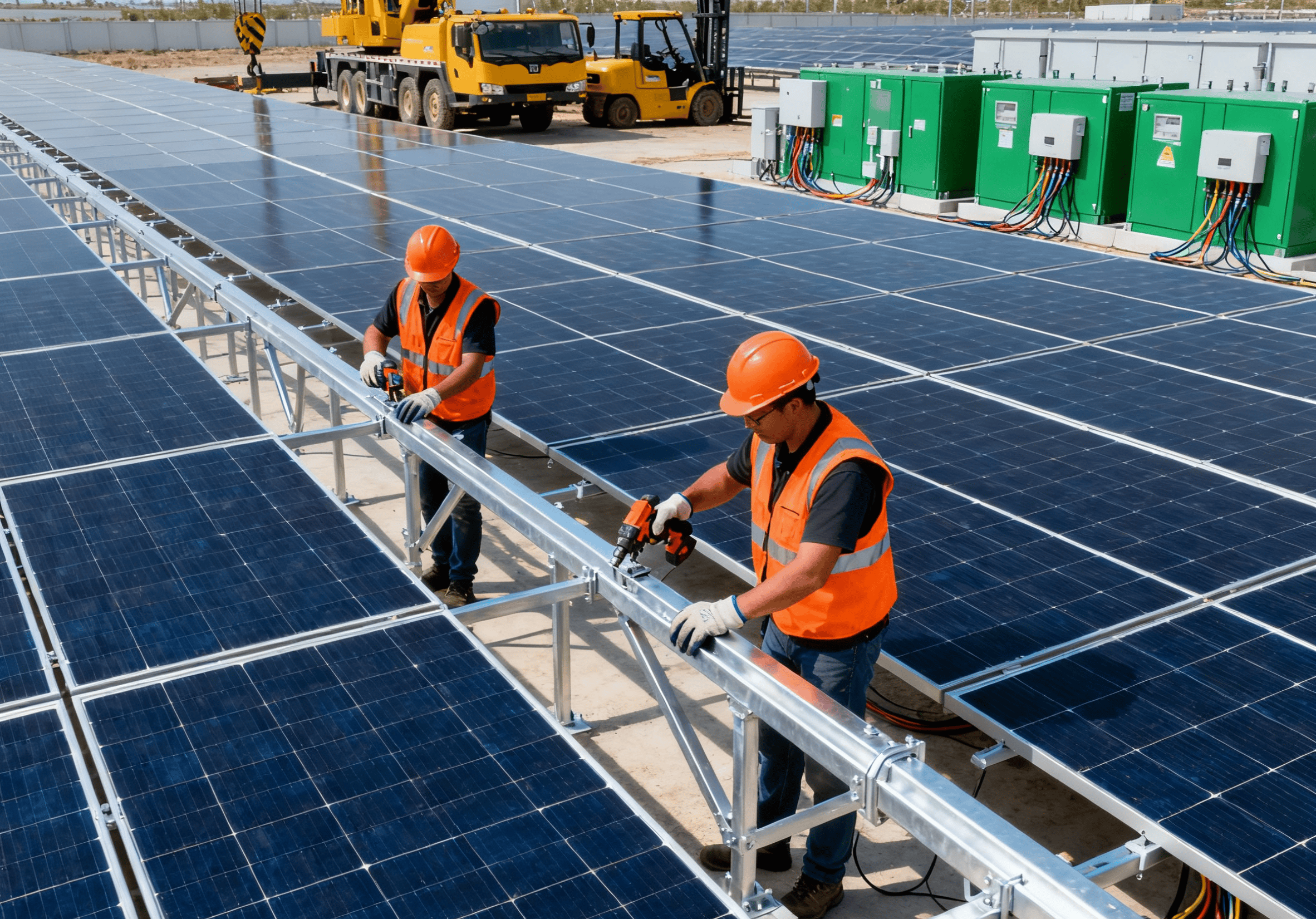
For African reference, SunnySky completed a 4×50kW solar power project in Cameroon, powering a commercial gas station complex — a real deployment in exactly the conditions this article describes.
Because SunnySky supplies both the hybrid solar inverter and the LiFePO4 battery as a matched system, the battery-inverter communication (CAN/RS485) is verified before shipment. That removes the single most common integration failure in African projects: an inverter and battery from different suppliers that never quite talk to each other properly.