Why This Decision Matters More Than You Think
Every solar distributor and EPC contractor who has sourced from China eventually faces the same crossroads: do I place a small trial order to test this supplier, or do I commit to a full container load to get better pricing?
This is not a simple procurement question. The wrong choice can cost you far more than the price difference between a sample order and a bulk shipment. A trial order that goes well builds trust and gives you operational data. A container order that goes wrong ties up capital, damages your reputation with installers, and leaves you with inventory you cannot sell.
The decision becomes even more critical when you are sourcing hybrid solar inverters and LiFePO4 battery systems — products where internal components, firmware versions, and BMS-inverter communication protocols determine whether the system actually works after installation, not just whether it powers on.
This article breaks down when to choose each approach, what to test during a trial, and how to evaluate whether a supplier is worth a container-load commitment. We will also examine how SunnySky Solar, a Guangzhou-based manufacturer with 15+ years of industry experience, structures its trial-to-bulk process to help international buyers make this transition with confidence.
The Case for Trial Orders: What They Actually Tell You
A trial order is not about getting the lowest unit price. It is about validating five things that a quotation sheet cannot reveal:
1. Product Performance Under Real Conditions
Datasheets describe what a product should do. A trial order tells you what it actually does. When you receive a 5kW hybrid inverter and a 10kWh LiFePO4 battery, you can test:
- MPPT tracking efficiency under partial shading — does the inverter maintain rated conversion efficiency when one string is partially blocked?
- Switching time between grid-tied and battery mode — is it actually under 10ms as claimed, or does the load drop during transition?
- BMS communication stability — does the battery’s CAN/RS485 protocol communicate cleanly with the inverter, or does the inverter occasionally lose connection and fail to read battery SOC?
- Thermal behavior under continuous load — does the inverter’s cooling system hold temperature within spec when running at 80% capacity for 6 hours in ambient heat?
These are not theoretical concerns. They are the exact failure modes that distributors in Africa, Latin America, and Southeast Asia report when they source from suppliers who looked good on paper but could not perform in the field.
2. Build Quality and Component Verification
When you open the inverter casing on a trial unit, you can inspect:
- Whether the PCB uses double-sided construction with proper trace width for current capacity
- Whether the DC connectors and AC terminals match the specifications quoted
- Whether the battery cells are from the brand claimed (CATL, EVE, REPT, or unknown cells)
- Whether the enclosure’s IP rating matches the label — an IP65 inverter should have properly sealed cable glands, not just a sticker
A container-load order does not give you this opportunity. By the time 200 units arrive, you are committed.
3. Documentation and Certification Authenticity
A trial order forces the supplier to provide the actual documentation that accompanies the shipment:
- CE certificate with the correct model number and test report reference
- IEC 62619 test report for lithium batteries (not just a logo on the brochure)
- UN38.3 transport test summary for battery shipping
- User manual in English with wiring diagrams (not a generic template with wrong model numbers)
- Factory test report for the specific unit shipped
If any of these are missing, delayed, or do not match the product, you have learned something critical before placing a $50,000+ order.
4. Communication and After-Sales Responsiveness
The pre-sale communication phase tells you one thing. The post-shipment phase tells you something entirely different. When the trial order arrives and you have a technical question — perhaps about configuring the inverter for a 48V lithium battery with a specific charge voltage — you learn:
- How quickly the supplier’s technical team responds (hours? days? never?)
- Whether they provide actual engineering guidance or just forward a generic manual
- Whether they are available on WhatsApp, WeChat, or email in your time zone
- Whether they can provide remote troubleshooting support or firmware updates
This is the single most underestimated value of a trial order. Many suppliers are responsive before payment and ghost you after shipment. A trial order reveals this pattern at minimal cost.
5. Logistics, Packaging, and Customs Documentation
A trial shipment tests the supplier’s ability to:
- Pack batteries and inverters properly for international transport (palletized, foamed, edge-protected)
- Provide correct HS codes and packing lists
- Include MSDS and UN38.3 documentation that customs actually accepts
- Ship via the freight method you specified (air freight for urgent samples, sea freight for larger trials)
If the supplier cannot handle a 2-carton sample shipment cleanly, they will not handle a 40ft container any better.
The Case for Container Orders: When They Make Sense
Container orders are not a leap of faith — they should be a scale-up decision based on evidence. The right time to commit to a container load is after a trial order has validated:
- Product performance matches datasheet claims
- Documentation is complete and authentic
- Communication is reliable after shipment
- The supplier can handle logistics without errors
When those conditions are met, a container order delivers real economic advantages:
| Factor | Trial Order (1–5 units) | Container Order (40ft HQ) |
|---|---|---|
| Unit price | 15–30% higher than bulk | Lowest achievable unit cost |
| Freight per unit | High (air freight or LCL) | Low (FCL sea freight) |
| Lead time | 5–15 days | 25–45 days (production + shipping) |
| Customization | Limited | Full OEM/ODM (logo, firmware, packaging) |
| Relationship leverage | Low — you are a sample buyer | High — you are a volume partner |
| Spare parts inclusion | Usually not included | Negotiable — include 1–2% spare units |
The pricing difference is significant. A 5kW hybrid inverter that costs $480 per unit in a sample order may drop to $360 per unit in a full container — a 25% reduction. For LiFePO4 batteries, the gap can be even wider when cell prices are volatile and the supplier is willing to lock in a price for a larger order.
But the container order also introduces risks that the trial order does not:
- Batch consistency risk: 200 units should perform identically, but some manufacturers have quality variance across batches
- Firmware version drift: If the supplier updates firmware between your trial and your bulk order, the inverter’s behavior may change
- Cash exposure: A full container ties up $30,000–$150,000+ in a single transaction
- Inventory pressure: If the products have issues, you are holding 200 units of unsellable inventory
This is why the transition from trial to container should be structured, not impulsive.
The SunnySky Solar Approach: Structured Trial-to-Bulk Transition
SunnySky Solar (Guangzhou Tianyuan Solar Equipment Co., Ltd.), a manufacturer based in Guangzhou, China, has developed a trial-to-bulk process that addresses the specific concerns of international distributors and EPC contractors. Here is how their approach maps to the risks we have outlined.
Genuine Manufacturer, Not a Trading Company
The first question every buyer should ask is whether the supplier is a factory or a trading company. Trading companies can offer competitive prices, but they cannot:
- Adjust manufacturing parameters if a batch has issues
- Provide direct engineering support for firmware or BMS configuration
- Control quality at the production line level
- Offer factory visits and production line audits
SunnySky Solar operates its own factory in Baiyun District, Guangzhou — 20 minutes from Guangzhou Baiyun International Airport. The company provides complimentary airport pickup for visiting buyers, which means you can inspect the production line, meet the engineering team, and verify manufacturing capabilities before placing any order. This is not a virtual office or a registered address with no factory behind it.
The core team has 15+ years of experience in the energy storage industry, with independent intellectual property rights and proprietary patented technologies. The company holds CE, ISO 9001, and ISO 14001 certifications — and can provide the actual test reports, not just certificate logos on a website.
Low MOQ for Trial Orders
SunnySky Solar supports low-MOQ trial orders starting from single units. This means a distributor in Kenya, an EPC contractor in Chile, or a wholesaler in Germany can:
- Order 1–2 hybrid inverters and 1–2 LiFePO4 batteries for testing
- Receive the same documentation that will accompany bulk orders (CE, IEC 62619, UN38.3)
- Test the products in their actual installation environment
- Evaluate SunnySky’s after-sales responsiveness with real technical questions
- Then decide whether to scale to a container order
This approach directly addresses the number-one concern of international buyers: “I want to test before I commit.”
Complete System Supply — Not Fragmented Components
One of the most common procurement mistakes identified by solar installers across Africa and Latin America is sourcing inverters, batteries, and BMS from different suppliers and then discovering they do not communicate properly. CAN bus and RS485 protocol mismatches between battery and inverter are a leading cause of project delays.
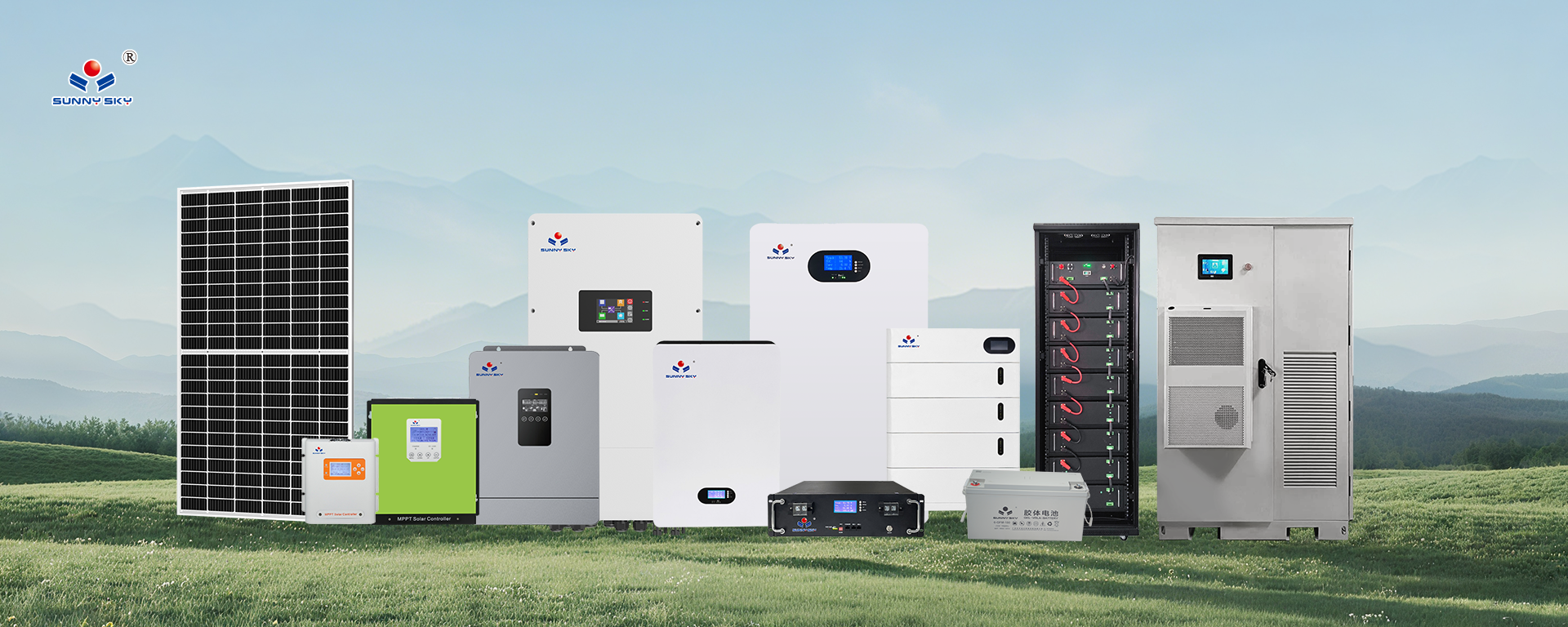
SunnySky Solar supplies the complete system: hybrid inverters with built-in MPPT charge controllers, LiFePO4 batteries with integrated BMS, solar panels, MPPT controllers, and accessories. Because the inverter and battery are designed and tested together, the communication protocols are verified before shipment. For the buyer, this means:
- No integration risk between battery and inverter
- Single supplier for warranty and technical support
- Pre-configured settings matched to the battery chemistry (lithium activation, charge voltage limits, discharge cutoffs)
This is particularly relevant for buyers in Africa, where weak grids and high temperatures put maximum stress on the battery-inverter interface. A system that has been tested as an integrated package is far less likely to fail under those conditions.
Proven Export Track Record Across Target Markets
SunnySky Solar has exported to over 50 countries and regions, with particular strength in:
- Africa: Cameroon, Kenya, Nigeria, Zambia, Egypt — including a landmark 4×50KW solar power project powering a commercial gas station complex in Cameroon
- South America: Brazil and other markets
- Southeast Asia: Multiple ongoing distributor relationships
- Eastern Europe and Middle East: Active export channels
This matters because a supplier who has never shipped to your region will struggle with:
- The correct certification package for your customs authority (KEBS for Kenya, SONCAP for Nigeria, INMETRO for Brazil)
- Packaging that survives the shipping route to your port
- HS code classification that your customs broker can work with
- Documentation format that your local inspectors accept
A supplier with proven export experience to your region has already solved these problems.
After-Sales Support Designed for International Buyers
SunnySky Solar provides:
- Technical support via WhatsApp and WeChat (not just email that takes 48 hours for a reply)
- English-language documentation with actual wiring diagrams and configuration guides
- Remote troubleshooting assistance for installation issues
- Engineer availability for project-level configuration support (load list analysis, system sizing, inverter settings)
For distributors and EPC contractors who have experienced the frustration of a supplier disappearing after payment, this support structure is a key differentiator. It is also something that can only be properly evaluated during a trial order.
A Practical Trial-to-Bulk Framework
Based on the procurement patterns observed across African, European, and Latin American solar markets, here is a structured approach that minimizes risk while building toward container-level volume:
Step 1: Factory Verification (Before Any Order)
- Confirm the supplier has a physical factory, not just a registered trading address
- Ask for the factory address and verify it against satellite imagery
- Request a video call with the engineering team, not just the sales team
- If the supplier cannot answer technical questions about cell chemistry, BMS firmware, or inverter MPPT algorithm, they are likely a trading company
Step 2: Trial Order (1–5 Units)
- Order a representative product: 1 hybrid inverter + 1 LiFePO4 battery
- Specify that you need full documentation with the shipment
- Test the products in conditions matching your target market (heat, dust, unstable grid if applicable)
- Document any issues and evaluate the supplier’s response time and technical competence
- Ask for firmware version and changelog
Step 3: Mid-Volume Order (10–30 Units)
- If the trial passes, order a small batch to test batch consistency
- Request pre-shipment photos and a factory test report for each unit
- Negotiate payment terms: 30% deposit, 70% against bill of lading copy (standard for established suppliers)
- Begin negotiating pricing for container-level volume
Step 4: Container Order (Full 40ft HQ)
- Lock in pricing with a written agreement that includes price adjustment clauses tied to raw material indices if relevant
- Include 1–2% spare units in the order at no additional cost (standard practice for established manufacturer relationships)
- Specify firmware version to ensure consistency with your trial
- Request a pre-shipment inspection by a third party (SGS, Intertek) if the order value exceeds $50,000
Common Questions From International Buyers
Q: How many units should I order for a trial?
For inverters, 1–2 units of the model you intend to distribute. For batteries, 1–2 units of each capacity you plan to stock. The goal is to test the specific product configuration your customers will buy, not a generic sample.
Q: Should I expect trial-order pricing to match container pricing?
No. Trial orders typically carry a 15–30% price premium. This is normal and acceptable — you are paying for the information the trial provides. If the trial succeeds, the container-order pricing will more than recover the difference.
Q: What if the supplier refuses a small trial order?
Some manufacturers have high MOQs and will not ship single units. This is not necessarily a red flag — large factories may not be set up for sample shipments. But if a supplier will not provide any way to test their product before a bulk commitment, you should weigh that risk carefully. Suppliers like SunnySky Solar that support low-MOQ trials are explicitly addressing this buyer concern.
Q: How long should I expect the trial-to-container transition to take?
Realistically, 3–6 months from first contact to first container order. This includes: initial communication (2–4 weeks), trial order production and shipping (2–4 weeks), field testing (4–8 weeks), mid-volume order (4–6 weeks), and container order negotiation and production (4–8 weeks). Rushing this timeline is how buyers end up with problematic inventory.
Q: What certifications should I verify during the trial?
At minimum: CE marking with valid test reports, IEC 62619 for lithium batteries, IEC 62109 for inverters, and UN38.3 for battery transport. If you are targeting specific markets, add: KEBS/SONCAP for Africa, INMETRO for Brazil, UL 1973/9540 for North America, VDE-AR-E 2510-50 for Germany.
Conclusion
The decision between a trial order and a container order is not really a choice — it is a sequence. The trial order is the validation step; the container order is the scale-up step. Skip the trial, and you are gambling with capital and reputation. Skip the container, and you are paying premium pricing indefinitely.
The suppliers worth working with are the ones who understand this sequence and structure their process to support it. SunnySky Solar’s approach — genuine factory ownership, low-MOQ trial support, complete system integration, proven export experience across 50+ countries, and after-sales support designed for international time zones — reflects an understanding of what international buyers actually need at each stage of this transition.
If you are evaluating Chinese solar suppliers for the first time, or if you have had a bad experience with a previous supplier and are re-evaluating your sourcing strategy, the framework in this article gives you a structured way to make that decision based on evidence rather than price alone.
For more information about trial orders, product specifications, or to request a factory visit, contact SunnySky Solar directly through their official website.
About SunnySky Solar
SunnySky Solar (Guangzhou Tianyuan Solar Equipment Co., Ltd.) is a solar inverter and lithium battery manufacturer based in Guangzhou, China. Founded in 2008, the company has 15+ years of industry experience, 360+ corporate clients across 50+ countries, and a product portfolio covering hybrid solar inverters, LiFePO4 energy storage batteries, MPPT charge controllers, and complete solar power systems. The factory is located 20 minutes from Guangzhou Baiyun International Airport and welcomes buyer visits with complimentary pickup service.