tianyuansolar@gmail.com

MPPT Solar Charge Controller Efficiency and Trends

  • Learning center
Posted by SUNNYSKY On Aug 29 2025

As the world increasingly turns to renewable energy, the efficiency and intelligence of our solar power systems have become paramount. At the heart of this evolution is the MPPT solar charge controller, a device that has fundamentally changed how we harvest energy from the sun. This crucial component is no longer just a simple regulator; it's the brain of a modern solar setup, ensuring every possible watt is captured and stored. Understanding the trends surrounding this technology is key for anyone looking to build a new system or upgrade an existing one for maximum performance.
MPPT solar charge controller, Maximum Power Point Tracking, solar charge controller reviews, best MPPT solar controllers

The Core Technology: Unpacking Maximum Power Point Tracking


The defining trend driving the adoption of these advanced devices is their core technology: Maximum Power Point Tracking. Unlike older PWM controllers that simply clip excess voltage, an MPPT controller is a sophisticated DC-to-DC converter that constantly analyzes the voltage and current from your solar panels to find the optimal balance, or 'maximum power point'. This intelligent process dramatically boosts solar charge controller efficiency, often by up to 30%, especially in conditions with variable sunlight, such as cloudy days or during early mornings and late afternoons. This gain means faster battery charging and more usable power from the same set of panels, representing a significant return on investment.

Current Trends: Identifying the Best MPPT Solar Controllers


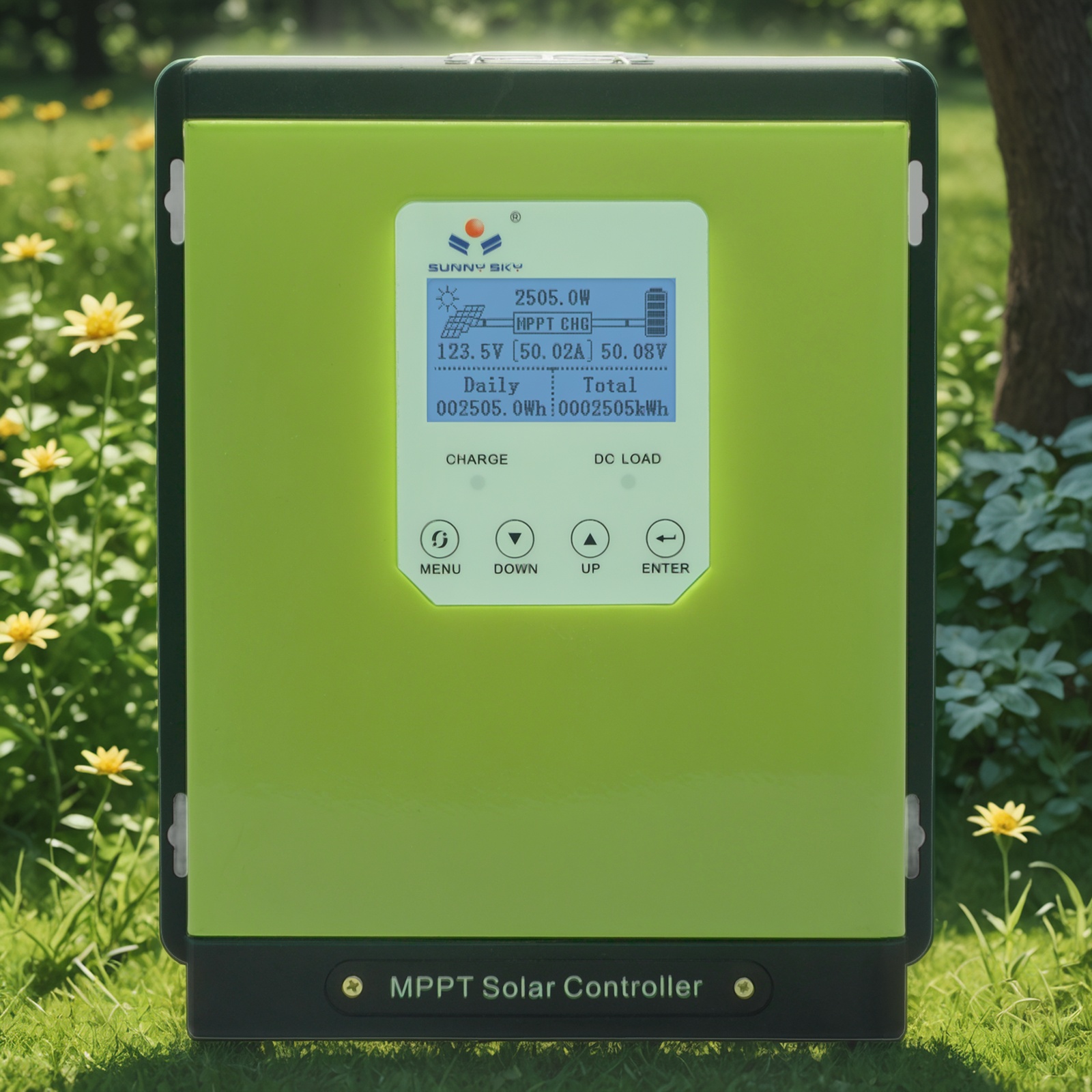
When searching for the best MPPT solar controllers on the market today, the trend is overwhelmingly towards smarter, more user-friendly devices. The era of cryptic blinking lights is over, replaced by intuitive LCD screens that provide a wealth of real-time data. Modern controllers, like the Sunny Sky MPPT, offer instant access to battery voltage, charge status, and detailed energy statistics. Furthermore, the rise of smart solar charge controllers with Bluetooth connectivity and dedicated mobile apps allows users to monitor and configure their systems remotely. This level of control and insight empowers users to manage their energy consumption more effectively than ever before.

Advanced Applications and Compatibility Trends


Another significant trend is the specialization of controllers for modern energy storage solutions. The growing popularity of lithium-ion batteries has created a demand for a dedicated solar charge controller for lithium batteries. These controllers feature specific charging algorithms designed to protect and extend the life of these advanced battery chemistries. For more complex systems, such as those with solar arrays facing different directions, the dual MPPT solar charge controller is becoming a popular solution. This technology allows each string of panels to be optimized independently, maximizing the harvest from non-ideal roof layouts. Alongside these advancements, manufacturers are also focusing on simplifying solar charge controller installation with clear connection terminals and user-friendly designs.

Making an Informed Choice: Solar Charge Controller Reviews


Navigating the expanding market requires careful research, and solar charge controller reviews are an invaluable resource. The current trend among consumers is to look beyond basic specifications and seek feedback on real-world performance and reliability. Prospective buyers should focus on reviews that discuss the accuracy of the Maximum Power Point Tracking algorithm, the ease of navigating the user interface, and the durability of the unit. A controller that provides clear, actionable data and is built to last offers the best long-term value, ensuring your solar energy system operates at peak efficiency for years to come.


Recommended Products

Featured Blogs

Tag:

  • Learning center
Share On
Featured Blogs
Solar System Acceptance Checklist: 10 Key Points for Beginners

Solar System Acceptance Checklist: 10 Key Points for Beginners

1. Visual Inspection: Flat board surface without cracks / Anti-corrosion treatment of bracket / Screws tightened without loosening. 2. DC Side: MC4 connector tightened and waterproof / Cables protected by conduit / Sufficient slack for easy maintenance. 3. AC Side: Independent circuit breaker + leakage protection / Bidirectional energy meter replaced / Terminal blocks tightened. 4. Grounding: Inverter casing / bracket / Grounding wire specification ≥ 4mm² continuous without joints. 5. Inverter: Normal grid connection and startup / Normal parameter display / Switching to off-grid mode within 20ms. 6. Monitoring: Successful APP binding / Data consistent with screen / Obstruction test alarm normal.

Can old and new batteries be mixed? Precautions for parallel expansion of energy storage systems (Introduction)

Can old and new batteries be mixed? Precautions for parallel expansion of energy storage systems (Introduction)

1. Risks of Mixed Use: Internal resistance mismatch leading to uneven current distribution, BMS protocol incompatibility, and wasted capacity. 2. Expansion Methods: New battery of the same model/BMS master-slave mode/Independent system/Complete replacement 3. Operation Steps: Confirm inverter support → Individual activation test of new battery → Power off and connect → Debugging and monitoring 4. Common Problems: New battery overheating/System alarm mismatch/Incomplete charging/Discharging/Efficiency reduction 5. Solutions: Reduce load, update firmware, recalibrate BMS, set new battery to charge-only mode 6. Conclusion: Mixed use is generally not recommended. The optimal solution is to expand capacity using the same model, with an independent system as the second choice.

Can a cracked solar panel still be used? A detailed explanation of four levels of damage.

Can a cracked solar panel still be used? A detailed explanation of four levels of damage.

1. Causes of cracks: Hail impact, thermal stress, installation pressure, handling bumps, aging. 2. Four-step assessment: Check crack location/shape/whether it is expanding/whether it affects power generation. 3. Level 1: Minor: Fine scratches/hairline cracks, impact <5%, no treatment required, continue use. 4. Level 2: Moderate: Obvious cracks that do not penetrate, impact 5%-15%, requires continuous observation. 5. Level 3: Severe: Through-crack/glass shattered, impact 15%-50%, must be replaced. 6. Level 4: Completely broken/frame detached, immediately disconnect power and replace.

Can solar energy systems still be used during consecutive rainy days? Energy storage configuration guide.

Can solar energy systems still be used during consecutive rainy days? Energy storage configuration guide.

1. Impact on power generation: Power generation drops to 10%-30% of sunny days on cloudy days, and only 1/5 of sunny days after a week of cloudy/rainy weather. 2. Three-stage effect: Daytime charging and discharging → Nighttime battery power supply → Battery depletion during continuous cloudy days. 3. Range reference: 10 kWh battery lasts 1-7 days, 20 kWh lasts 2-14 days, 30 kWh lasts 3-21 days. 4. Configuration recommendation: Designed to last at least three days, with a power rating slightly higher than the inverter. 5. Practical tips: Use high-power appliances during the day, pay attention to weather forecasts and plan ahead. 6. Extreme solution: A hybrid of photovoltaic + energy storage + diesel generation, suitable for "uninterrupted power" needs.

tianyuansolar@gmail.com
+86-13711660041
+8613711660041
WhatsApp :WhatsApp QR Code


