Understanding the Hybrid Solar Inverter: Revolutionizing Renewable Energy Management
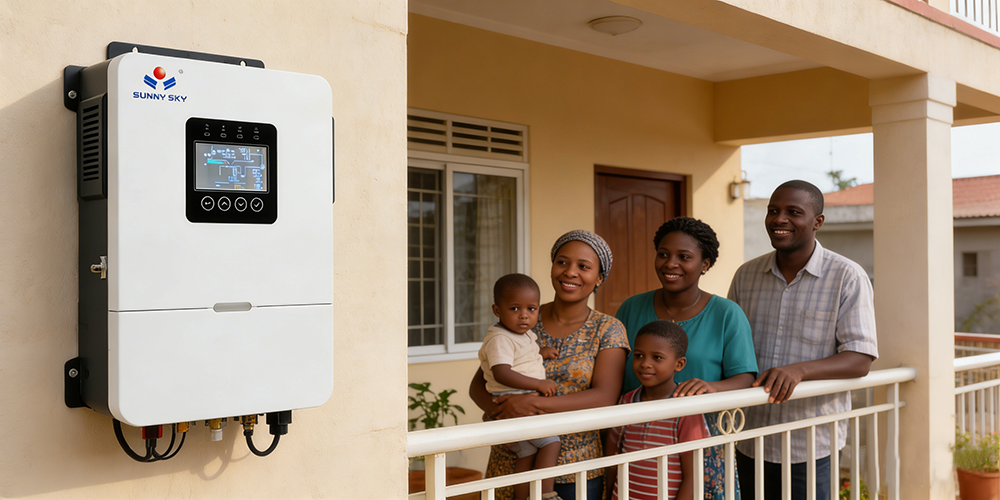
In the evolving landscape of renewable energy, the hybrid solar inverter stands as a pivotal technology, enabling seamless integration of solar power with traditional grids. As a leading hybrid solar inverter manufacturer, Guangzhou Tianyuan Solar Equipment CO.,LTD, under the SUNNYSKY brand, delivers cutting-edge solutions that optimize energy efficiency and sustainability. This article delves into the technical intricacies of hybrid solar inverters, exploring their design, functionality, and role in modern solar energy solutions.
Core Technology Behind Hybrid Solar Inverters
A hybrid solar inverter is engineered to convert direct current (DC) from solar panels into alternating current (AC) for household or commercial use, while also managing battery storage and grid interactions. Unlike traditional solar power inverters, which focus solely on PV input, hybrid models incorporate bidirectional capabilities, allowing excess energy to charge batteries or feed back into the grid. This functionality is achieved through advanced pulse-width modulation (PWM) and maximum power point tracking (MPPT) algorithms, ensuring up to 98% conversion efficiency.
From a technical standpoint, the inverter's topology often employs a multi-stage conversion process: first, DC-DC boosting to stabilize voltage from variable solar inputs, followed by DC-AC inversion using insulated gate bipolar transistors (IGBTs) for high-frequency switching. SUNNYSKY's patented technologies enhance this by integrating smart energy management systems (EMS) that prioritize solar usage, reduce grid dependency, and minimize harmonic distortion below 3%. As a premier hybrid inverter supplier, our designs support parallel operation, scaling from single units to multi-inverter arrays for larger installations.
Advanced Features in SUNNYSKY's 12KW and 6KW Models
SUNNYSKY's 12KW hybrid solar inverter exemplifies robust engineering for high-demand applications. With a sleek white enclosure featuring the vibrant Sunny Sky logo, it houses an intuitive digital display that provides real-time metrics on voltage, current, power output, and battery status. The user interface includes capacitive touch buttons for precise configuration of charge priorities, discharge limits, and anti-islanding protections, compliant with IEEE 1547 standards.
For versatility, the renewable energy inverter supports multiple input sources—solar arrays up to 18KW, AC grid, and battery banks with lithium-ion or lead-acid compatibility. Its hybrid functionality employs adaptive algorithms to switch between on-grid, off-grid, and hybrid modes seamlessly, with zero-transfer time during outages. Cooling is managed via intelligent fans and side vents, maintaining operational temperatures below 60°C under full load. Similarly, the 6KW model offers scaled-down efficiency with the same core tech, ideal for residential setups, boasting a compact form factor and advanced MPPT for optimal PV harvesting even in partial shading.
As a China solar factory, we leverage proprietary R&D to incorporate anti-corrosion coatings and IP65-rated enclosures, ensuring durability in harsh environments like coastal or dusty regions. Our solar inverter production processes adhere to ISO 9001 and CE certifications, guaranteeing reliability across diverse climates.
Applications and Benefits in Solar Energy Solutions
Deploying a hybrid solar inverter unlocks comprehensive solar energy solutions for both residential and commercial sectors. In residential scenarios, it enables energy independence by storing surplus daytime generation for nighttime use, potentially reducing electricity bills by 70-80%. Technically, this involves dynamic load balancing, where the inverter monitors real-time consumption and solar yield to minimize grid draw, supporting peak shaving and demand response programs.
Commercially, as a solar technology factory in China renewable energy hubs, SUNNYSKY powers microgrids and EV charging stations. The 12KW unit, for instance, handles three-phase outputs up to 400V, integrating with SCADA systems for remote monitoring via Modbus or Wi-Fi protocols. Benefits extend to environmental impact: by optimizing self-consumption, these inverters cut carbon emissions by facilitating higher renewable penetration, aligning with global net-zero goals.
Moreover, our commitment as a China solar factory includes ongoing innovations like AI-driven predictive maintenance, which analyzes performance data to preempt failures, extending system lifespan beyond 10 years. Clients in over 50 countries benefit from this stability, with products designed for easy installation and scalability.
Why Choose SUNNYSKY as Your Hybrid Inverter Partner
Guangzhou Tianyuan Solar Equipment CO.,LTD, located just 20 minutes from Guangzhou Baiyun International Airport, invites global partners to our state-of-the-art facility. We offer complimentary airport pickups and guided tours to showcase our solar inverter production lines, where precision assembly meets rigorous testing.
SUNNYSKY's dedication to "delivering reliable, innovative green energy" drives us to invest continuously in R&D, enhancing inverter efficiency and grid resilience. Whether sourcing a solar power inverter for off-grid adventures or large-scale solar technology factory outputs, our hybrid inverter supplier expertise ensures tailored solutions that reduce energy costs and environmental footprint. Embrace the future of renewable energy inverter technology with SUNNYSKY—your trusted ally in sustainable power.